- 9 years ago
-

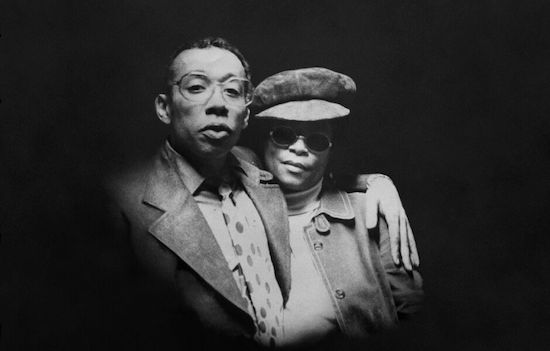
The second film from Swedish director Kasper Collin, I Called Him Morgan is an evocative, beautifully filmed documentary of a remarkable life cut short and a remarkably fertile period in New York City’s jazz scene. In February 1972, acclaimed 33-year-old trumpeter Lee Morgan was shot to death by his common-law wife Helen in an East Village club. The murder shocked all who knew the couple, including Morgan’s fans and fellow musicians, many of whom tried to make sense of the tragedy afterwards.
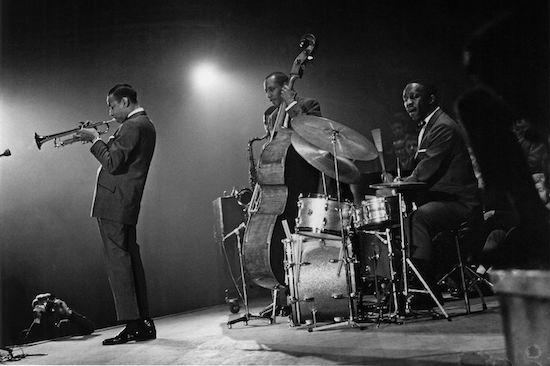
Using interviews; gorgeous, iconic, black and white still photos; archival film clips, and moody reenactments—all underscored by a fabulous soundtrack—Collin constructs compelling portraits of both Lee Morgan and his common-law wife Helen, making their way in New York City’s hopping jazz scene from the late 1950s through the early ’70s. The story slowly builds up to that fateful night, providing details that many have apparently pondered for years. In doing so, Collin gives us a glimpse of the great talent possessed by Morgan, along with poignant memories of the people who nurtured and appreciated it. With its potent music, atmospheric footage of vintage NYC and artfully abstract recreations, the film also gives us a palpable sense of time and place.

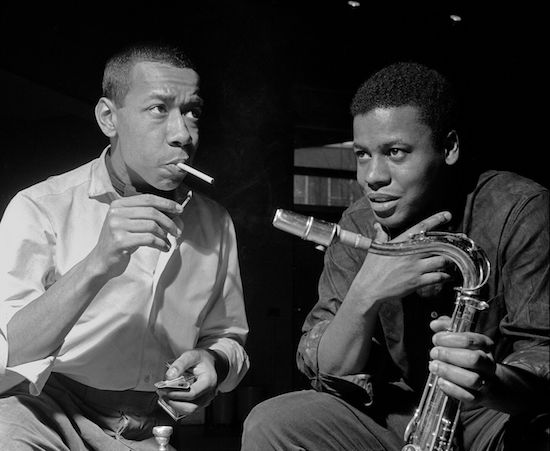
Photo: Francis Wolff, Mosaic
Collin’s main resource is an interview that Helen gave to radio host and jazz scholar Larry Reni Thomas in 1996, a month before she passed away. This fortuitous conversation came about when Thomas was teaching adult education at a Wilmington, N.C., high school and she happened to be one of his students. The tape, shown being played on an old cassette player, has a scratchy, otherworldly sound, rendering Helen’s raw testimony all the more haunting.
We hear her story alternated with Lee’s, the latter mainly provided by musicians like one-time bandmate (Art Blakey’s Jazz Messengers) and friend Wayne Shorter, who remembers first seeing teenage Lee playing with Dizzy Gillespie in the late 1950s. Very young and very talented, the Philadelphia-born Morgan is recalled as dapper and confident. We also hear excerpts from an interview that Lee himself gave in the early 1970s, in which he sounds as sharp and cool as his music.
Insightful interviews are provided by various bandmates and other luminaries in the scene, including Jymie Merritt, Bennie Maupin, Albert “Tootie” Heath, and Billy Harper, who chart the rise of Morgan’s career in New York, followed by his descent into heroin abuse and subsequent career collapse. Helen is recalled as a fixture in their circle, a strong presence (and great cook) who would provide meals to musicians in her 53rd Street apartment. Originally from rural North Carolina, she had escaped the privations of the farm, first moving to Wilmington where she had children while still in her teens, then to New York City when her first husband died. Her son, Al Harrison—only 13 years her junior—tells of first meeting his mother when he was 21, among other recollections.

Photo: Ben van Meerendonk
It was Helen who took the fallen Morgan under her maternal wing, sending him to rehab, acting as manager and getting him club dates, and generally taking care of everything. As one acquaintance notes, “She had almost adopted a child.” (The film’s title refers to the fact that Helen didn’t like or use her husband’s first name.)
We also meet Lee’s friend Judith Johnson, with whom he quickly developed a strong bond. As Lee spent more time with her, sometimes neglecting to come home at night, Helen became resentful of being relegated to Lee’s “main woman,” a role she had no intention of fulfilling, as she tells Thomas frankly. Neither woman was supposed to be at Slug’s Club where Lee was performing on that snowstorm-plagued night in February, a fact that makes the resulting tragedy seem all the more random and senseless.
I Called Him Morgan is clearly a labor of love for Collin, whose 2006 documentary My Name Is Albert Ayler was similarly enlightening and evocative. Those who already revere Morgan will undoubtedly find the film fascinating; those who might not be familiar with the artist will probably be inspired to seek out his music.
I Called Him Morgan opens on Friday, March 24, at the Film Society of Lincoln Center.
—Marina Zogbi
Latest News
- 9 years ago
-

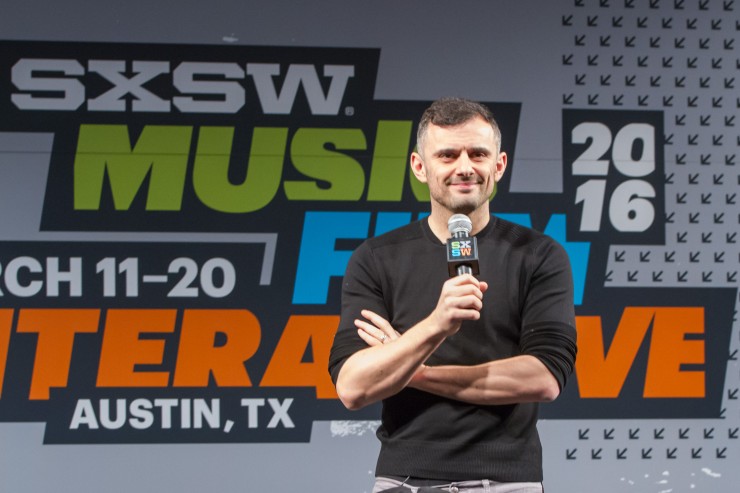
With each year the staggering list of shows grows larger, but we’re here to help with this not so shiny, quite diverse list of recommendations to help you sort it all out.
Monday, March 13th
Idgy Dean – The Parlor Room, 88 Rainey St – 7pm
Sylvan Esso – AV Club Presents Just Another Manic Monday @ The Mohawk – 10:45 pm
Girl Pool – Do512 Party @ Hotel Vegas – 1 am
Tuesday, March 14th
Wu Tang Clan w/ Thievery Corporation – ACL Live at the Moody Theater – 11:00pm
The Districts – Buffalo Billiards – 1:10am
Spoon – The Main – 1:00am
Sleigh Bells – Stereogum Party @ Empire Garage – 1:00am
Plastic Pinks – Fine Southern Gentlemen – 2:00am
Wednesday, March 15thMaybird – Taco Bell Feed the Beat – 1:00 pm
The Avett Brothers – ACL Live at the Moody Theater – 11:00pm
Tokyo Police Club – Bungalow – 12:00am
Grandmaster Flash – Clive Bar – 11:00pm
The New Pornographers – Stubb’s – 12:20am
Field Trip – The Market – 1:00am
Thursday, March 16th
Julie Byrne – Pitchfork Day Party @ French Legation Museum – 12:30 pm
Lo Moon – YouTube @ The Coppertank – 3:00 pm
The Big Moon – South by San Jose @ San Jose Hotel – 4:00 pm
BBC 6 Music Presents @ Latitude 30 – 12:00 amBeach Slang – BrooklynVegan @ Cheer Up Charlie’s – 5:00 pm
Pell – Stub Hub party @ Bangers – 6:00pm
Ecstatic Vision – Grizzly Hall – South By South Death – 9:00pm
Girl Pool – Anti- Records Party @ Elysium – 11:00pm
Friday, March 17th
Womps – Sidebar – 12:00pm
DJ Anthony Parasole – Barcelona @ 12:00am
Weezer – Brazos Hall – 12:00am
Gary Clark Jr. w/ The Mystery Lights – Levi’s Outpost – 9:00pm
Dem Yuut & Loamlands – Barracuda Backyard – 8:00pm, 10:15pm
We Are Wolves – Swan Dive Patio – 9pm
Be Charlotte – Esther Follies – 10:00 pm
Saturday, March 18th
Mather Logan Vasquez – Waterloo – 12:00pm
Future Generations – Kebabalicios – 4:00pm
Mister Saturday Night, Justin Miller, Nik Mercer – Kingdom – 8:00pm
Tkay Maidza – Do512’s The Big One @ Barracuda – TBD
- 9 years ago
-

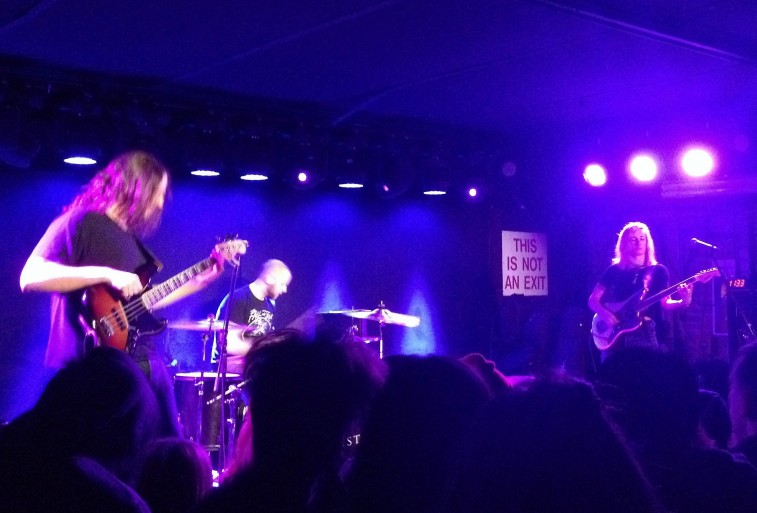
In some recent discussions with musicians, bands, DJ’s and musical creatives, I made the point that for me, a flat performance is pretty much a worthless one. If you can’t take people on a musical journey than it’s just plain boring. It’s the bands and DJ’s that can cross genres that get my attention. Case and point, Tell All Your Friends PR turned us on to the new album from rock trio, Slothrust. After listening to the album, I decided to do a review for the blog. I have to admit, sometimes I don’t get past the first track, but “Surf Goth” got my attention. The idea that they would start the album with an instrumental track was enough for me, and when the show began on Saturday evening at Mercury Lounge it was the first track they played.
Let me start by saying, their sound is on-point and very powerful. Particularly for a trio. They have great chemistry on stage, and their fans (including me) are really into them. Musically, the band members are equally impressive as they effortlessly worked through songs that range from blues to grunge with elements of jazz.
While Kyle Bann (bassist) had a continuous grin on his face, Leah Wellbaum maintained a certain attitude as drummer Will Gorin fiercely hit the skins as if it was possibly his last opportunity to play this year. Highlights from the new album- “Like a Child Hiding Behind Your Tombstone,” “Mud,” “Sleep Eater,” and “Trial & Error,” which Wellbaum explained she wrote in high school. From the older material- “7:30am” and “Magnets, Pt. 2.”
It’s easy to understand why the band appeals to so many people. Musically, they are highly talented, and smart, catchy lyrics such as “Don’t shake hands with the lonely kids because I hear that shit’s contagious” really grab you. If you have the chance to see them live, don’t miss out.
Upcoming Dates: 3/6, Johnny Brenda’s: Philadelphia, PA – 3/7, Black Cat: Washington DC – 3/9, Marble Bar: Detroit, MI – 3/10, Schubas Tavern: Chicago, IL – 3/11, Duck Room: St Louis, MO- 3/12, Tank Room: Kansas City, MO – 3/15, Larimer Lounge: Denver CO – 3/18, High Water Mark Lounge: Portland, OR – 3/20, Sunset Tavern: Seattle, WA – 3/22, Bottom of the Hill: San Fran, CA
- 9 years ago
-
Courtesy of Film Movement
Written and directed by Boo Junfeng (2010’s Sandcastle), Apprentice is a quiet yet gritty drama about a newly hired young prison guard who is “promoted” to working on death row. (It was Singapore’s official entry for the 2017 Best Foreign Language Film Oscar.) Unlike other movies of its genre, Apprentice doesn’t go for big, sweeping statements or emotions, but instead shows one man struggling with a soul-wrenching job as he comes to terms with his own family’s past.
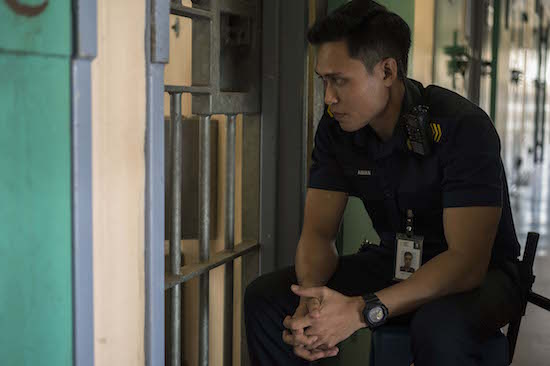
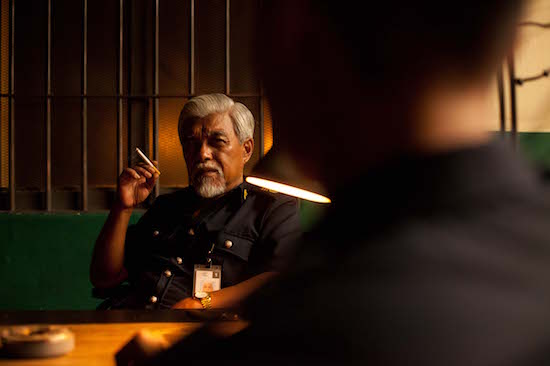
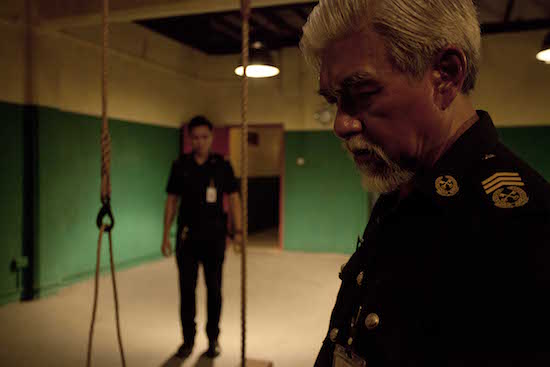
We first meet Aiman (newcomer Fir Rahman) as he’s being interviewed for a position as a guard in a maximum security prison. His stated reason for being there is idealistic: he wants to help people change. Initially, pending a background check, he has limited security clearance, i.e. no access to the “condemned cells.” Scenes of him joking around with prisoners in the yard and helping them with shop equipment indicate that he truly does want to help. He glimpses an older, white-haired man in the cafeteria and there is a wary recognition. This is Chief Rahim (played by the excellent Wan Hanafi Su).
Courtesy of Film Movement
Later, when helping another guard move equipment in the condemned block, Aiman brings himself to the attention of Rahim by volunteering information about where to get a certain type of rope. As the camera casually hovers over an open trap door, we realize that this is where hangings take place. The no-nonsense tone and mundane conversation illustrate the businesslike nature of death here.
Scenes at the prison alternate with scenes of Aiman’s rundown apartment, which he shares with his older sister. They don’t have a lot of money and she doesn’t like him working at the prison. When Aiman tells her that he’s met “the hangman,” we find out that Rahim executed their father years ago, when Aiman was a baby.
The chief takes a shine to Aiman and later seeks him out to help fix the scale used to weigh condemned prisoners in order to calculate a quick death. They exchange personal information, including the fact that Aiman had once been a rebellious gang member. He asks pointed questions about the prisoners that Rahim has executed and and later tries to find his father’s files.

Courtesy of Film Movement
When Aiman’s supervisor asks about his family, we learn he was raised by grandparents. He is clearly both haunted by his father’s memory and afraid of being discovered as his son; why exactly does his want to work at the prison? His sister, who is planning to marry her boyfriend and move to Australia, wants Aiman to go with them. Meanwhile Chief Rahim asks Aiman to “learn the ropes” and be his assistant. “We are humane,” he reiterates while instructing Aiman in the specific science of hanging, which is shown very matter of factly, all the more chilling.
As more details unspool about Aiman’s father and his legacy, we see the rituals surrounding hanging and the toll that it takes on both its perpetrators and prisoners’ families. (Capital punishment in Singapore has not traditionally been reserved for murderers only.) The film becomes increasingly more disturbing as we follow one inmate through the steps leading to his death and aftermath. The conflicted Aiman eventually erupts into an emotional confrontation with the chief, with dramatic results.
Apprentice is an unusual look into the specifics of capital punishment and death by hanging, as well as a drama about a man who is driven by his own demons to work in such a place. One of the film’s assets is the compassionate way it deals with both the doomed prisoners and guards who grapple with the emotional toil of their jobs. Junfeng has created a quietly powerful film that makes its point without fanfare and is all the stronger for it.
Apprentice opens on Friday, March 3, at Village East Cinema.
—Marina Zogbi
- 9 years ago
-

We recently caught up with musician, singer, song writer and visual artist Yoni Wolf to discuss the new album from his band Why?. Moh Llean will be released on March 3rd, and is the band’s first release since 2013’s Golden Tickets.
What was the band’s motivation/inspiration for the latest album, “Moh Llean” and how is it different than the band’s previous releases?
I can’t say there is ever a specific motivation or inspiration. We are artists and we are drawn to making art in whatever state– from whatever space we find ourselves. This one was no different, though of course it ends up with its own feel and identity based on our changes and developments as humans.
Is there a particular story you wanted to tell or message you wanted to send with “Moh Llean.”
I would say that whatever the album conveys thematically, it does so naturally without pre-conceptions or agenda. That said, I think it is an attempt at openness in the heart and acceptance and peace.
How did the hip hop element of the band’s sound come to be? Are you guys hip hop fans? Classic or modern day hip hop? Or, was it organic?
I started out as a rapper. Hip hop is at my roots and core. I don’t think this album is very hip hop though.
Tell me about the band’s creative process. Do you work remotely or do you go off to the woods to write together as a group?
I wrote most of the stuff myself. My brother Josiah and I produced and arranged the stuff together. We have a couple musicians– Doug McDiarmid and Matt Meldon, who played on every song, and then about 10 or 12 others who played on a song or two or three.
What band’s or musicians have been major influences?
Life, The Universe, God or the thought experiment to envision whatever that is.
What role does the audience – live or otherwise – play in Why?’s universe?
They enable us to do this. Without an audience there would be no one to communicate these ideas to and therefore no reason to continue.
What do you enjoy most about playing live?
I like the catharsis of singing. It’s like the greatest thing in the world. Doesn’t matter if you sound like Bon Iver or a see-saw. I think everyone should sing.
Is a European tour in the works for this album?
For sure. May/June. 🙂
Visual art seems to be an important part of the band’s work. Are any of the band’s member’s visual artists? Did any of you attend art school?
Yes I am and did. I make all the album art (with help from my lay out designer friends).
What message would you like to send to AFP’s artist community in these rather important and challenging times for artists?
Hang in there and always try to convey your most vulnerable truth through your art. Or just have fun or whatever.
-Frank Jackson