- 8 years ago
-

Art For Progress sits down with creative mastermind Alfie Rustom to learn more about his debut novel: The Bioman™ Chronicles: #2084 (Book 1). Learn more at www.thebiomanchronicles.com
Do you see yourself in this imaginary character?
Yes, I see myself in this character. But, I also see every other post-modern human in this character, too. Culturally, we have forgotten our connection to nature. Bioman is designed to help us reconnect with our own miraculous biology and remember our intimate connection and oneness with nature.
What are Bioman’s best traits as a super hero?
At first glance, Bioman can appear serious, formal, and proper. He loves traditions and old-school values that uphold patience, hard work, honor, and social and cultural responsibility.
In #2084 story, he begins as a ‘norm’ who has been programmed to dislikes difference but then slowly loosens up and learns to embrace and celebrate his ‘anomalous’ self and diversity in others. Although, this is a constant struggle for him.
Does Bioman fit in with the other marvel comic superheros or is Bioman standing alone in his quest?
Bioman offers an alternative to Marvel/DC’s duopoly on superheroes designed for needs of the last century. Bioman is designed specifically for the concerns/aspirations of the 21st century.
Millennials, in particular, know they have inherited an eco-system and political economy that was created by the excesses and eco-ignorance of baby boomers. They are seeing their children being programmed by media, consumed by technology and threatened by faceless terrorist hordes.
The constant worrying about the kind of planet their children will inherit leads them to feel helpless. The Bioman experience is designed to change all that. The franchise will allow parents and their children to explore, evolve and expand what it means to be human, encouraging them to reconnect with their biological-selves and reclaim their place in the cosmic order of things and gain the courage to take effective action to defend nature.
What would you say are the most important goals for this project?
Bioman’s explorations of science, technology, and consciousness will attract audiences worldwide who long to deepen their connection with nature, with each other and who want technology to be used for human as well as planetary well-being.
Who are some key people working with you on this project? Are there any names people will/should know?
I’m currently in development of a short animation with an upcoming studio. I’m in dialogue with some legends from the superhero business including a former CEO of Marvel.
Tell us about your plans for the film? Do you have a date in mind for the film release?
The live action movie has been budgeted/scheduled with an Oscar winning team. The epic budget means I will develop an anime for theatrical release, first. A successful anime should attract a large enough studio to partner on the project.
Do you have any upcoming events or any recent events to share regarding this project?
I’m fairly active on social media – @RealBioman (Instagram, Facebook, Twitter), and will be planning more events as the fan-base for Bioman grows.
What inspired you to become a writer?
I arrived in NYC a few days prior to 9/11, and experienced the horror of ground zero at first hand. Shortly after, I developed a passion for screenwriting from a screenwriter who was also the daughter of legendary the playwright of The Elephant Man. She helped me realized that stories have the power to transform how we see the world.
What does the phrase Art for Progress mean to you?
In my current view, art that’s not for progress is not real art. Now, more than ever, we need art to take a stand against the tyrannical forces vying for domination.
Latest News


- 8 years ago
-
One of the things I used to detest so much as a child was watching the Spanish actress Charo shaking her ass and screaming out “cuchi, cuchi!” on stage. Her famous act would make my blood boil. Please, Charo, forgive me (for we are both Spanish, Latin women) but you’re capitalizing on broken English and the need to be sexy all the time, and I wonder if you helped shape the brand, image for Latin women.
There is more to my personal history with Charo’s legacy than growing up watching her on television: my paternal grandmother was a performer too and there was a crossing of paths between these influential Latin women. Seeing such a beautiful Latin woman depicted in Charo’s characteristic way was beyond me. I questioned this image constantly, wondering about the advantages of being famously sexy and vulnerable. As opposed to all the women in my family who were immigrants and championed higher education. They worked as professionals, speaking fluent English, and every single one of them was extraordinarily attractive.
On one hand, I saw Charo as a brilliant entrepreneur. She seized the opportunity to commoditize a stereotype and hence became a star with a net worth of twelve billion dollars. In a society where money is synonymous with power, that is a ton of power.
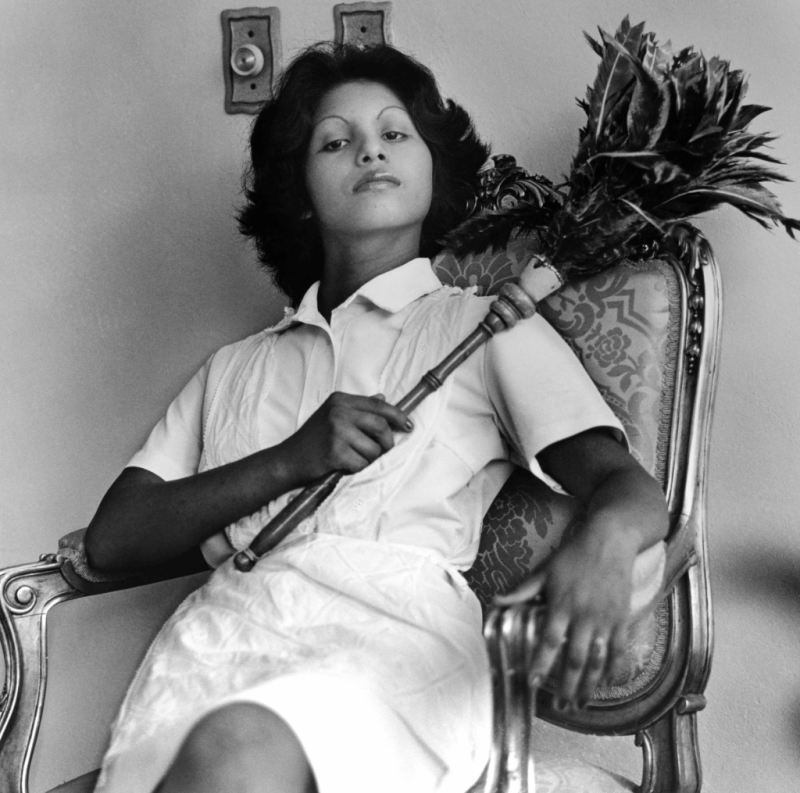
In contrast to Charo’s sexy Latina character, Panamanian artist Sandra Eleta tapped into another Latin female stereotype by photographing housemaids, albeit, with a much different attitude depicted in her subject’s countenance than say Charo’s blaring “Cuchi, cuchi!” and blank expressions. The women depicted in Eleta’s work were laborers, and yet, had a “different face than what you might expect from a domestic worker,” observed assistant curator Carmen Hermo when discussing the works of Eleta during a recent interview in The Guardian Magazine about the group exhibition Radical Women: Latin American Art, 1960-1985 at the Brooklyn Museum. The problem with the latter is the artist went unnoticed for her work, for years. Like all the Latin artists in the group exhibition, Eleta was using the body as protest without any seductive intention, however as assistant curator Hermo, noted the faces on the subjects were distinct from what one expects from the “cliché housemaid.” After I examined the photograph Panamá (Edita [the one with the duster] Panama), 1977 I agree that there was something subtly peculiar exuding from the subject’s face and body that was powerful, authoritative, relaxed and sensual.
Sandra Eleta (Panamanian, b. 1942), “Edita (la del plumero), Panamá” (Edita [the one with the duster], Panama), 1977, from the series “La servidumbre (Servitude)” 1978-1979. Black and white photograph. 19 × 19 in. (48.3 × 48.3 cm). Courtesy of Galeria Arteconsult S.A., Panama. Artwork © the artist
Why is it that the Latin woman came to be depicted with such contrasting messages? Regardless of culture, is this not true of women in general? Artist Kara Walker presents this discussion in her work, Subtley, 2014 at the Domino Sugar Factory in New York. The giant foam sculpture covered in sugar greeted viewers on one side with juicy, kissable lips on her face, and on the other side, her vulva exposed, while wearing a headpiece associated with the stereotypical mammy in African-American culture. Walker successfully mirrored an image controversially in the middle of sexual fantasy and political incorrectness. It becomes slippery when a female uses the body as a form of rebellion: it all depends on which context it is being understood, and that is directly linked to the viewer. With recent sexual allegations against Hollywood mogul Harvey Weinstein, surfacing from many actresses (a diverse group of color and race), it is apparent that the female revolution has turned into a war between the sexes to protect our rights to our bodies and how we use it.
Meanwhile, Afro-Latina artists like Cardi B who use their body to get what they want as she confidently belts out in songs like “Bodak Yellow,” or “I Like it Like That.” Who’s not to say she is using her body as a weapon. Cardi B hit instant success on social media for candidly discussing her history as a stripper and hard life. In her video for “Bodak Yellow,” the artist raps about all her financial accomplishments due to stripping and goes on readily admitting to “using guys” and “feeling damn powerful.” The drawback I have with using the body so freely is: why give away the core to sex so easily? Isn’t this where the power is at?

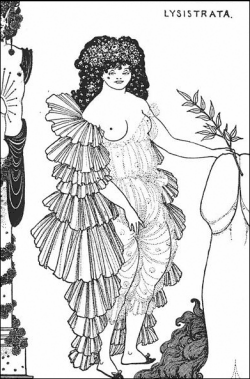
Illustration of Lysistrata by Aubrey Beardsley, 1896
In Lysistrata, a comedy written by Aristophanes in 400 BCE, the queen orders the women of the village to abstain from *sex with the men to force submission as an entrance to negotiate peace. Of course, the women groan and complain but fulfill the request and the plan worked. Later on, in 2013, Independent UK covered a story on Colombian women who refused to have *sex with their spouses and significant others until a hazardous 35-mile road was repaired. Both of these instances illustrate women using their bodies in rebellion, but this time they are adamant about withholding sex. We can ask ourselves if the platform to the truest female power is this simple. Is using our body as a performative vessel without sex the key to the ultimate power we seek? At least, just to get the message across of true empowerment.
Cardi B declares “He wanna swim with his face / I’m like okay, I’ll let him did what he want / He buys me, Yves Saint Laurent.” She goes on to say that she works hard. Well, many women work very hard and as mentioned in the instance of Radical Women: Latin American Art 1960-1980 whose roster of Latin female ( although it would have been great to include contemporary artists) exemplified women who went unnoticed while using their bodies stupendously in silent dissent. The ammunition in creativity was intellectually superior and their tactic to inject themselves into political protest through the arts was indeed “clever.”
All in all, the Latin woman is defined as a radical extremist as she focuses heavily on conversations dealing with the political dictatorship, misogyny, and abuse common in all Latin American and Latin Caribbean nations.

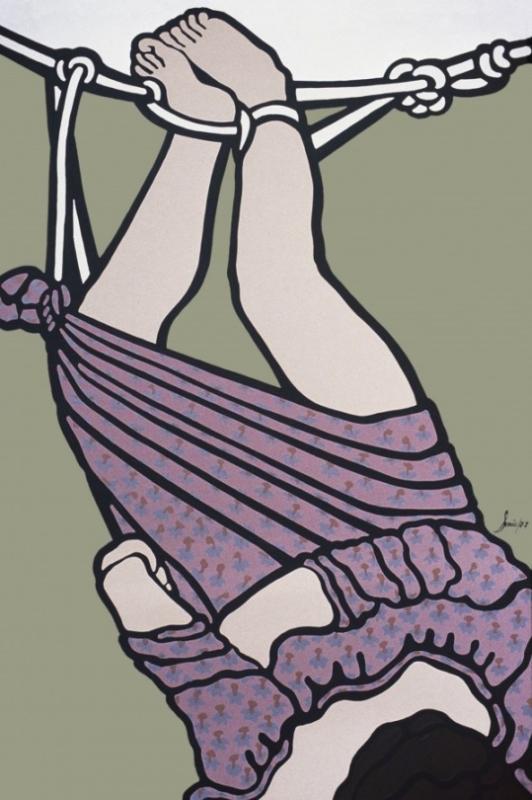
Sonia Gutierrez (born Colombia, 1947). Y con unos lazos me izaron (And they lifted me up with rope), 1979. Acrylic on canvas. Museo de Arte Moderno La Tuertulia, Cali, Colombia. © Sonia Gutierrez.
This discussion is not meant to compare the unfortunate historical events that have unfolded for the African-American or Latina woman. This is a conversation meant to highlight stereotypes that exist in the West about cultures considered “other.” To further elaborate, women in the West have received recognition in popular culture for shaking their asses, banking on looks, while those in fine arts who question dictatorships, abuse, inequality, the objectification of body and sexual assault are oftentimes operating under the radar of popular culture and/or ignored. Another work in Radical Women: Latin American Art 1960-1985 by artist Sonia Gutiérrez, And they lifted me up with rope, 1977, depicts a woman wearing a bright pink dress with rope wound up around her ankles as she suspends in mid-air. The image reveals bright, appealing colors against the nightmarish reality of the hunted on display like a trophy. It’s as though being a woman with a vagina is asking for trouble, more so, if the woman happens to be attractive, sexy and sensual.
On the contrary to the aforementioned, Gutiérrez’s subject is wearing a homely, frumpy garment. There is nothing sexy about the attire, so what caused the subject to fall victim to such a violent act of assault? It is apparent that anytime a woman, regardless of color, race or sexual preference decides to investigate topics (like Gutierrez did in her work which isn’t a favorable one or requires uncomfortable participation from the viewer, think men here, sorry fellas), they are ostracized, labeled as difficult and pushed out of society with the consequence of a harder life—in all aspects. Is it easier to view works that don’t confront this stigma because it is un-disturbing and easy to see a beautiful woman but not have to hear her?
I have often wondered if the stereotypes were created as a form of psychological warfare on members of society that those in power wanted to oppress. Which begs the question: why do women who play along with these stereotypes gain financial wealth and social recognition while the brash, intellectual woman is snubbed?
It is really difficult to persuade those unaffected by inequality or abuse to understand what the protesting is about. I invoke on Curator Cecelia Fajardo-Hill’s statement, “You can’t say it didn’t exist” when speaking about the female artists in Radical Women: Latin American Art, 1960- 1985. These women, among many other great Afro-American, Indian and non-Western artists have been lamenting the need for change, silently in their works for years and it has been falling on deaf ears. It is so painful knowing this truth. It is not a myth and it shan’t be disregarded.

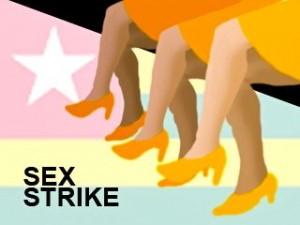
Activists with Atitude: ● 2006, Colombia — Proclaiming a “strike of crossed legs,” women in Pereira withheld sex to stop gang wars and drive home the point that violence is not sexy. The ten-day strike may have worked. By 2010, Pereira’s murder rate declined by 26.5 percent.
As I sit back and watch the (gender) social earthquake take place, raising the stinking, hidden hell, sitting beneath us for centuries, I applaud female curators such as Cecelia Fajardo-Hill and Carmen Hermo (among others not mentioned) step into the exhibition arena. It is exhibitions like this, focusing on women, that will continue to address haunting issues women face and hopefully eliminate inequality: or maybe the exhibition space and the help of the curator will provide the support we need to capitalize on our intelligence and desire for social change.
Maybe the female raucous will bring in the proper respect we have been waiting for while making a hefty living too. Besides, men have figured out how to go to war and make money, and Charo banked on a stereotype and look at her today. I guess we can learn a thing or two about stereotypes.
by Beláxis Buil
Edited by Abel Folger
- Other Sex Strikes:
http://activistswithattitude.com/sex-strikes-and-birth-boycotts-no-laughing-matter/
- 8 years ago
-
 The life of an independent artist can be both very rewarding and very trying. On the one hand, if you pursue this path it’s likely you’re doing so to chase a passion, and few things can be quite as enriching. Yes, you’ll see plenty of even successful artists bemoaning the lifestyle and recommending young artists find other employment – but deep down, they’re doing what they love to do. It’s just that it isn’t easy. On the other hand though, particularly when you’re starting out, finding reliable, paid work as an independent artist is far easier said than done.
There is no formula for earning money as an artist. It takes talent, initiative, and a little bit of luck. However, we have a few ideas for some modern outlets that the independent artist in 2018 can at least explore for potential income opportunities.
Patreon
For those who haven’t looked into it yet, Patreon is an innovative modern platform designed to help artistic people get funding. Basically, it’s similar to crowdfunding sites, but built for private artists. You post your work, or access to it, and “patrons” can pay to support it. The main idea is financing, but Patreon is also a fantastic way to gain exposure. If your work is good and you’re strategic about your use of the platform, you can build a legitimate following through this service.
Online Courses
If you do have any sort of following – through Patreon, social media exposure, previous sales, or whatever else – you can always explore the avenue of running an online course also. It’s not for everybody, but private instruction can bring in some nice supplemental income, and it doesn’t have to be that much work. Even getting 10 people to sign up for, say, a 10-video course at $100 each can get you a nice little chunk of cash in a matter of weeks. You’ll have to build to the point at which you can charge that kind of money and students will trust and respect your perspective, but it’s certainly worth exploring.
Game Art
This may sound oddly specific, but video games are coming out at an incredibly fast rate these days, and many of them are designed on tight budgets – meaning the creators might be looking for some help with cover art. And we aren’t just talking about console titles. New mobile games come out on a daily basis, and a massive portion of all internet gambling features online games. There are tons of online and mobile games, and doing some cover art for even one of them can lead to significant exposure and potentially more opportunities. You’ll have to hustle a bit to talk to and negotiate with game designers, but it’s a nice modern option to keep in mind.
Creator Art
Here we’re talking about a concept similar to that of making game cover art, but for other creative types: writers, musicians, and these days even podcasters. These people might not be primarily focused on visual art but at the end of the day they all need covers. And particularly now that so many creative types publish their own content online, independently, they might be interested in accepting help in an unorthodox manner. And again, doing a few covers for any kind of content that becomes popular – and making sure you can take credit – can lead to more exposure and opportunity.
Networking
A lot of modern artists would likely deem this the most important step toward making a career out of independent work. Networking tips for artists include simple but necessary ideas like meeting other artists (and offering support to them), seeking connections over sales, following up on new contacts, etc. Often, you gain the most exposure (and eventually more sales of your private work) the more people you know. And if you’re a regular presence in a community of artists and do your best to promote their work, they’ll likely do the same for you – meaning you magnify your audience with each fellow creative you successfully engage with!

- 8 years ago
-
Long known for billing top grade, sophisticated acts that cover indie, jazz, electronic and everything in-between. West Village staple Le Poisson Rouge hosted a special event on Sunday, ‘I Feel Pride.’ The heated dance party was not only dedicated to NYC Gay Pride, but also the 10th anniversary of the music venue.
Aptly named LPR X, the yearlong event series presents an eclectic roster of headlining acts – both previous and new to the venue. Considered the founder of disco, Italian producer Giorgio Moroder hosted and headlined the night.
Moroder is considered key to Donna Summer’s rise to fame, producing “Love to Love You Baby” and “I Feel Love.” He is also responsible for the timeless movie soundtrack tunes “Take My Breath Away” (“Top Gun”), Irene Cara’s “Flashdance … What a Feeling” and Blondie’s “Call Me” (American Gigolo). Moroder wrote compositions for “Superman III,” “Rambo III,” “Beverly Hills Cop II,” and “Scarface.” Over the course of 50 years he has not stopped his output, working with premier acts including Barbra Streisand, Elton John, David Bowie, Lady Gaga, Eurythmics and Daft Punk, et al.
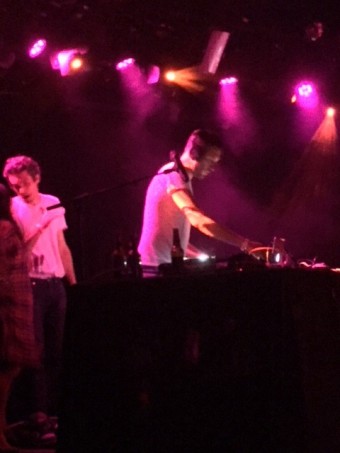
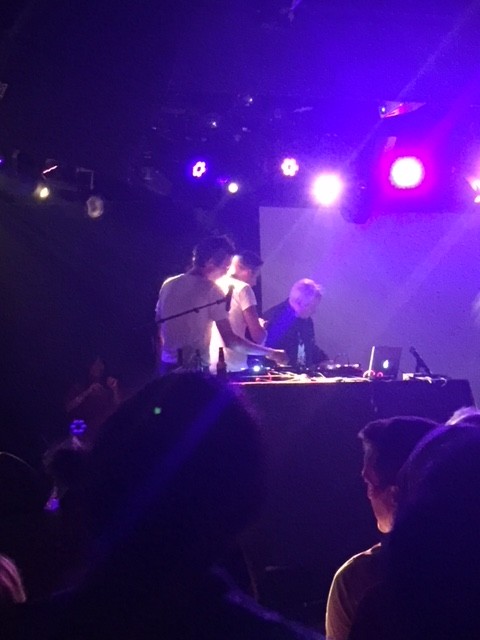
The night was truly standout due to the caliber of artists, who bought a heavy arsenal of quality music. The crowd also contributed, as gays, straights and people of all persuasions convened on the darkened dancefloor for opening act Holy Ghost. The duo played an uplifting, funky set of electro and disco house, seamlessly mixing and building up their set. The room was lively as ever as revelers downed drinks and danced the night away. Patrons hung onto every beat and synth line, anticipating where Holy Ghost would take them next.

At the end of their set, Holy Ghost left the room begging for more. Afterwards, the crowd greeted Giorgio Moroder with cheers and enthusiasm, as he smiled and graced the stage. His relentless set had the crowd riled up as he played a medley of his Grammy-winning hits, plus remixes of his most famous tunes. “Hot Stuff” really took the house down as the room continued to fill up with fun-loving party people. For a man who is 78 years old, he more than showed his mastery of the art of DJing.

All-in-all, Le Poisson Rouge hit all high marks in putting together a remarkable pride event with music that, however different, are aligned in the history of electronic, dance, pop and disco.
- 8 years ago
-

Art for Progress is pleased to announce a summer music & arts program for NYC high school students. The program is designed for students who are interested in a career in the arts and music.
Workshops in music and visual arts will be offered over four dates between mid-July and mid-August. These 4 hour workshops will include guest speakers, professionals in both the visual arts and music. The guest speakers will share their knowledge, guidance and experience as professionals in the art world.
The main objective of the program is to provide continued instruction over the summer months for students who are considering a future career in the arts. Students can also be graduates who are looking for additional instruction before heading off to college or art school.
The planned student to teacher ratio will be 10-15 students with a total of 40-50 students for each date. Space will be limited, and will be on a first come first serve basis. Students can choose to attend one or more workshops, but we suggest you attend all four. Please sign up as soon as possible to secure your place. The specific dates, location (Manhattan) and times will be available soon.
These are the dates for the workshops:
Workshop 1– Sunday, July 22nd- 10:30am – 2:30pm (lunch provided)
Workshop 2– Sunday, July 29th- 10:30am – 2:30pm (lunch provided)
Workshop 3– Sunday, August 5th- 10:30am – 2:30pm (lunch provided)
Workshop 4– Sunday, August 12th- 10:30am – 2:30pm (lunch provided)The location for the workshops is Teatro Latea @ The Clemente Soto Velez Center, 107 Suffolk Street, 2nd floor, rooms 202 & 203, New York, NY.
Each session will include a 30 minute career development session with a professional artist/musician.
To sign up, contact us for a simple, one page application form.
By e-mail: summerarts@artforprogress.org, For questions, contact Barry Komitor at (347)661-2469
This program is funded by a generous grant from the Henry Matisse Foundation.