- 7 years ago
-
This year IKT Congress (International Association of curators of contemporary art) gathered in Miami, Florida for a four-day program of discussions, artist studio visits, presentations and exhibition tours. One of IKT’s board members and Miami resident Ombretta Agró Andruff organized the sprawling, successful itinerary throughout Miami and Miami Beach. It included ICA, RFC ( Rubell Family Collection), PAMM ( Peréz Art Museum), Wolfsonian among a few others.

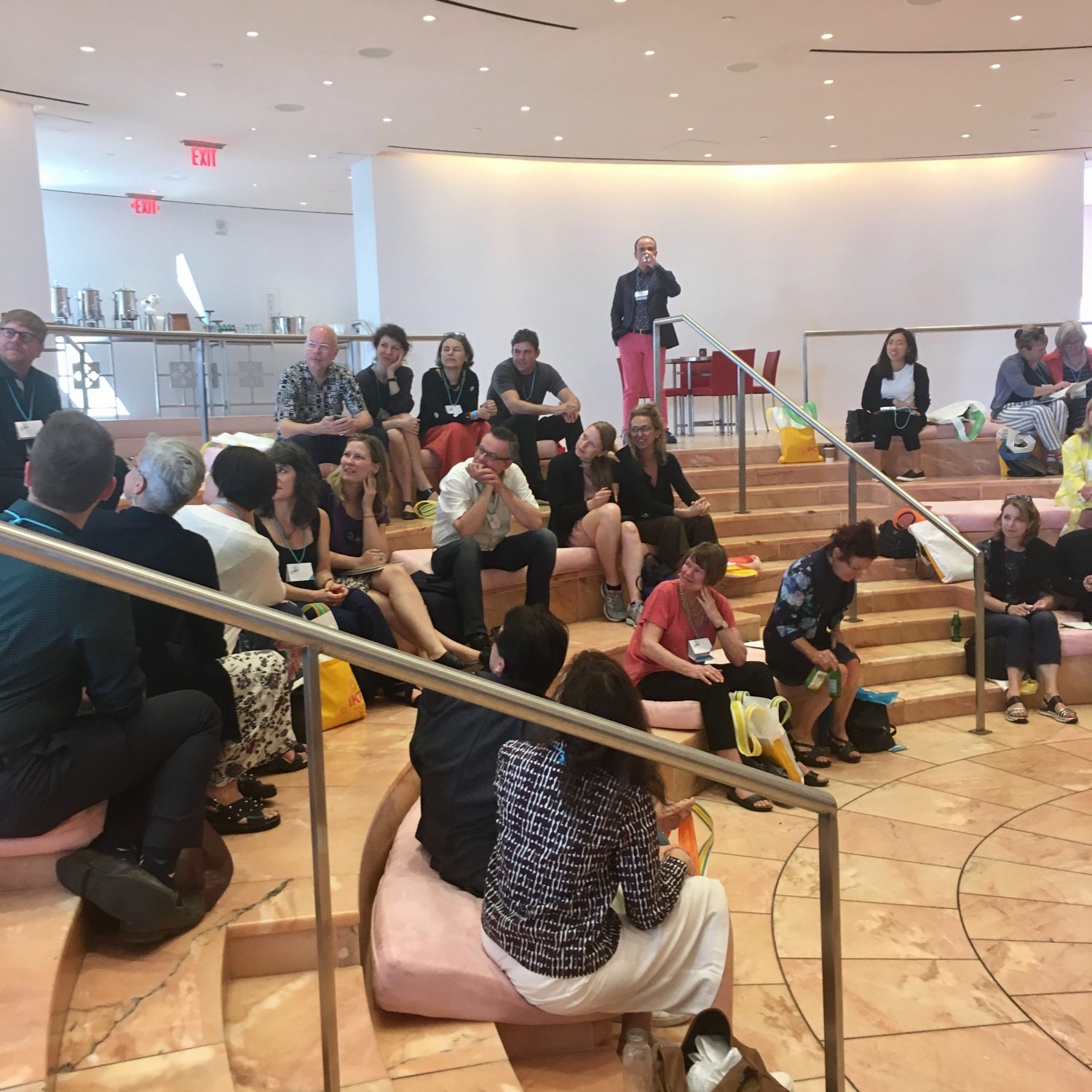
Curators introducing themselves during
IKT General Assembly at Faena Forum, Miami Beach.One of the best aspects of this year’s curatorial assembly, was the theme “exploring issues of resilience and sustainability in cultural production.” The assembly connected Latin American and Caribbean curators to an impressive network of European, Canadian, Mediterranean, North American and Australian scholars in the field. Curators of diverse backgrounds had the chance to speak intimately, exchange ideas and establish professional connections that could lead to future collaborations in Miami and abroad. Additionally, Miami-Dade County Art in Public Places offered scholarships to local curators that covered expenses for the four-days. Plus, they selected visual artists to present 5- minute rounds during Long of Arts in Public Places. This was lead by Amanda Sanfilippo at the RFC ( Rubell Family Collection).
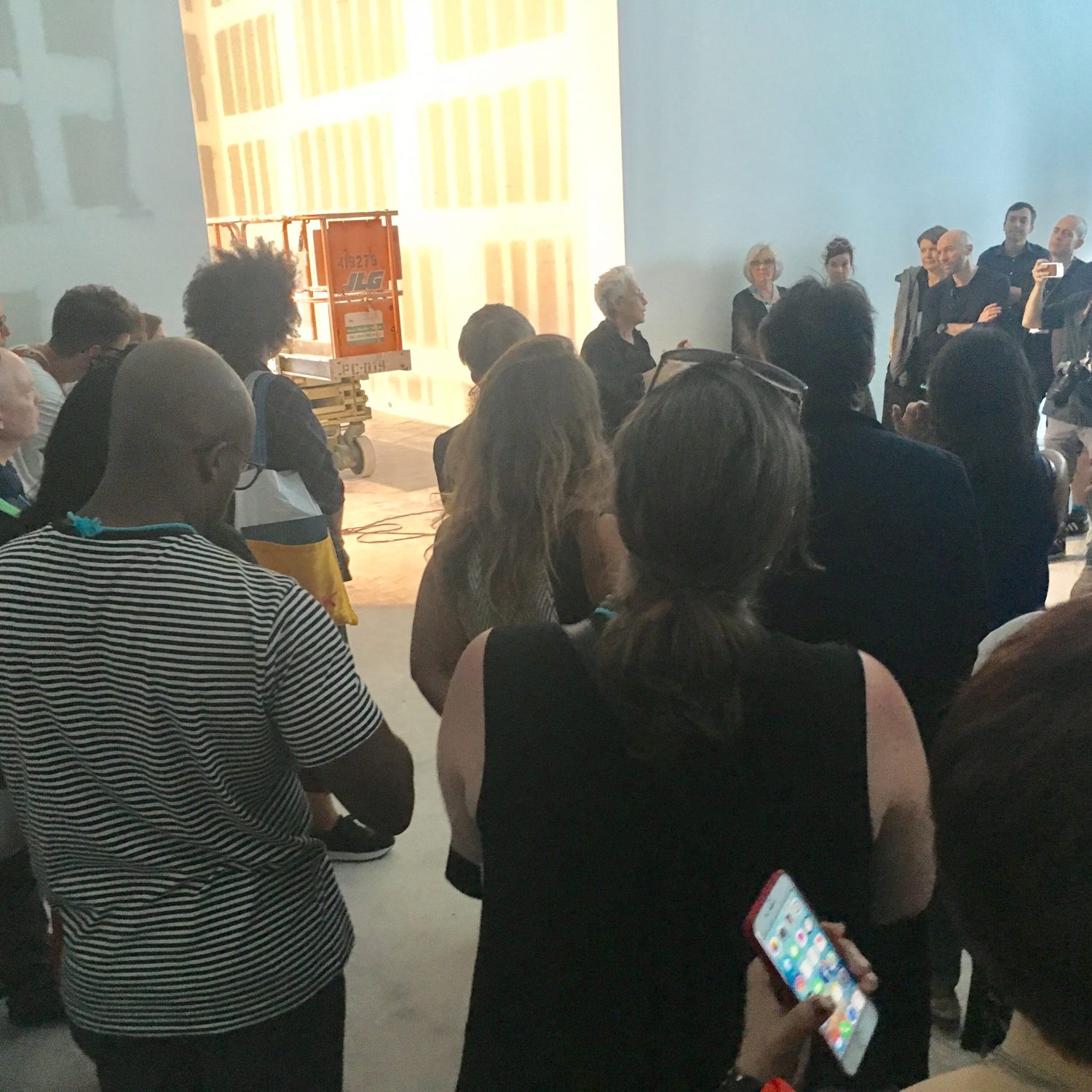
Over the four days, curators traveled throughout the city and experienced highlights such as a first-time public walk through of RFC’s future museum location, a group exhibition Room for Failure curated by Omar López-Chahoud at Piero Atchugarry and hearing Rosa De La Cruz speak candidly on the De la Cruz Collection and their approach to helping young artists at NWSA ( New World School of the Arts). These particular moments exemplified the fire that exists in Miami’s art ecology. With a focus on figures in the community with a passion for moving Miami’s artistic landscape forward, it allows the attendees one step closer to their private space of familiarity. Other moments, such as the 5-minute rounds at the RFC, seemed to trail off a bit. Some of the artists veered away from the structure, and at times even the dialogue was sloppy. The result was a lengthy discussion that distracted the curators from sitting through the visual presentation and seeing compelling works Miami has to offer.

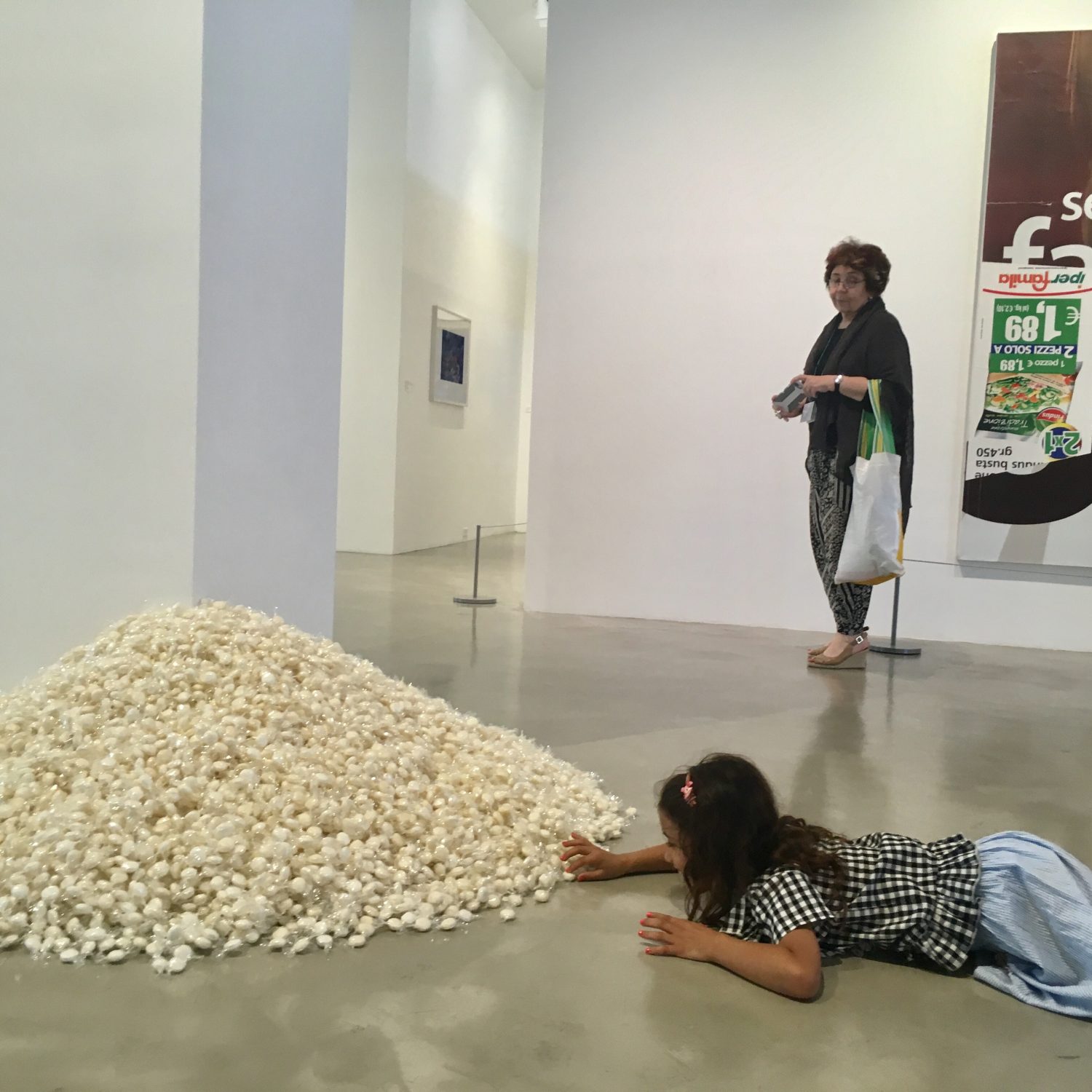
Félix González-Torres installation at the De La Cruz Collection. Design District, Miami Mera Rubell speaking to the assembly of curators while on tour of new location in Miami.
Fortunately, the last day of IKT Congress, PAMM presented Suiting-Up, an outstanding collaboration between artists Lucinda Liberman and Kim Yantis. Both artists paired up to create fashion that intersects survival gear, functionality, and performance. The performance opened with a video projection. Liberman narrated a small segment that described each performer’s style as a character, set in the bleak future of Miami’s climatically altered environment. Each person’s wardrobe enabled them to adapt to their new home. It was a simple presentation that went straight to the point, and IKT’s assembly of curators responded well.
The four days not only offered a close view of artist’s work to the curators, but also a healthy challenge for Miami artists to be innovative and engage in new opportunities. IKT Congress’ team did a great job at rounding up Miami’s gems, nurturing talent and connecting cultural institutions to fresh curatorial voices. Additionally, the association opened windows for curators looking to collaborate with other curators, and exposed the city to new, possible ventures.

Written by Beláxis Buil
Latest News

- 7 years ago
-
Traveling opens one’s eyes to truths that otherwise become lost to distance, suspicions, and misinformation. By traveling, we connect with cultures and find out about crippling circumstances that may impair individuals from being included in global communications in which they should participate.
During a recent trip to Costa Rica, I found some surprising facts on the local view on art. First, I must disclose: aside from national institutions, there are hardly any galleries in the city of San Jose. Some of the residents claim an enormous problem with the few public works facing vandalism or individuals uncertain of art’s purpose in a town, or even as a serious career.
It is true that cultural institutions such as the National Museum of Costa Rica and the Jade Museum boast an extraordinary dose of Pre-Columbian art and jade artifacts. MADC ( Museo de Arte y Diseño Contemporáneo) exudes a lovely exterior and has gained the public interest of many traveling abroad because it is one of the only contemporary art spaces in the city.
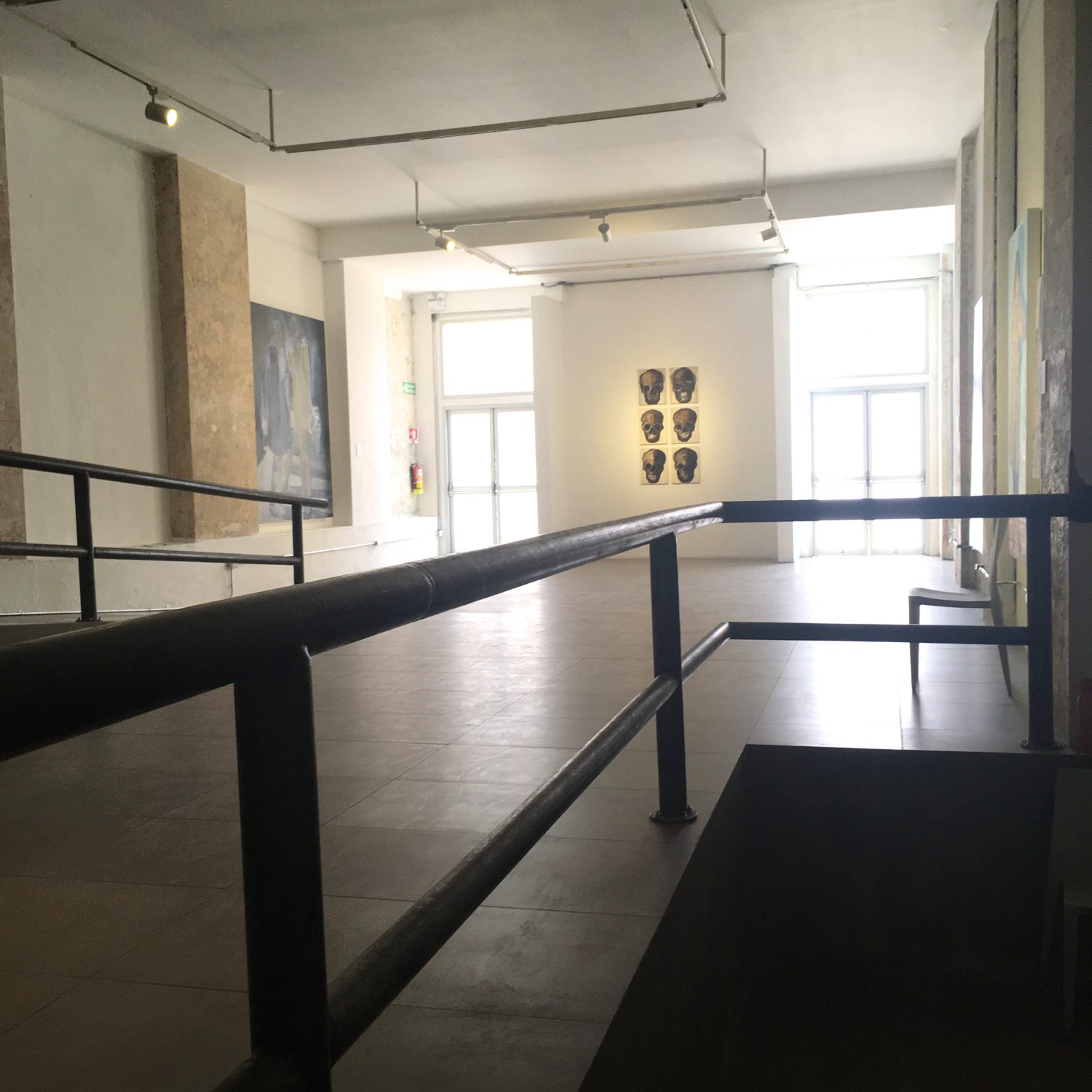
Upon entering the space, there were two modestly small galleries. The first had a few paintings wrapped in plastic. It seemed as though a transition of works was taking place. The second displayed smaller pieces lined up in a row or salon-style arrangements.
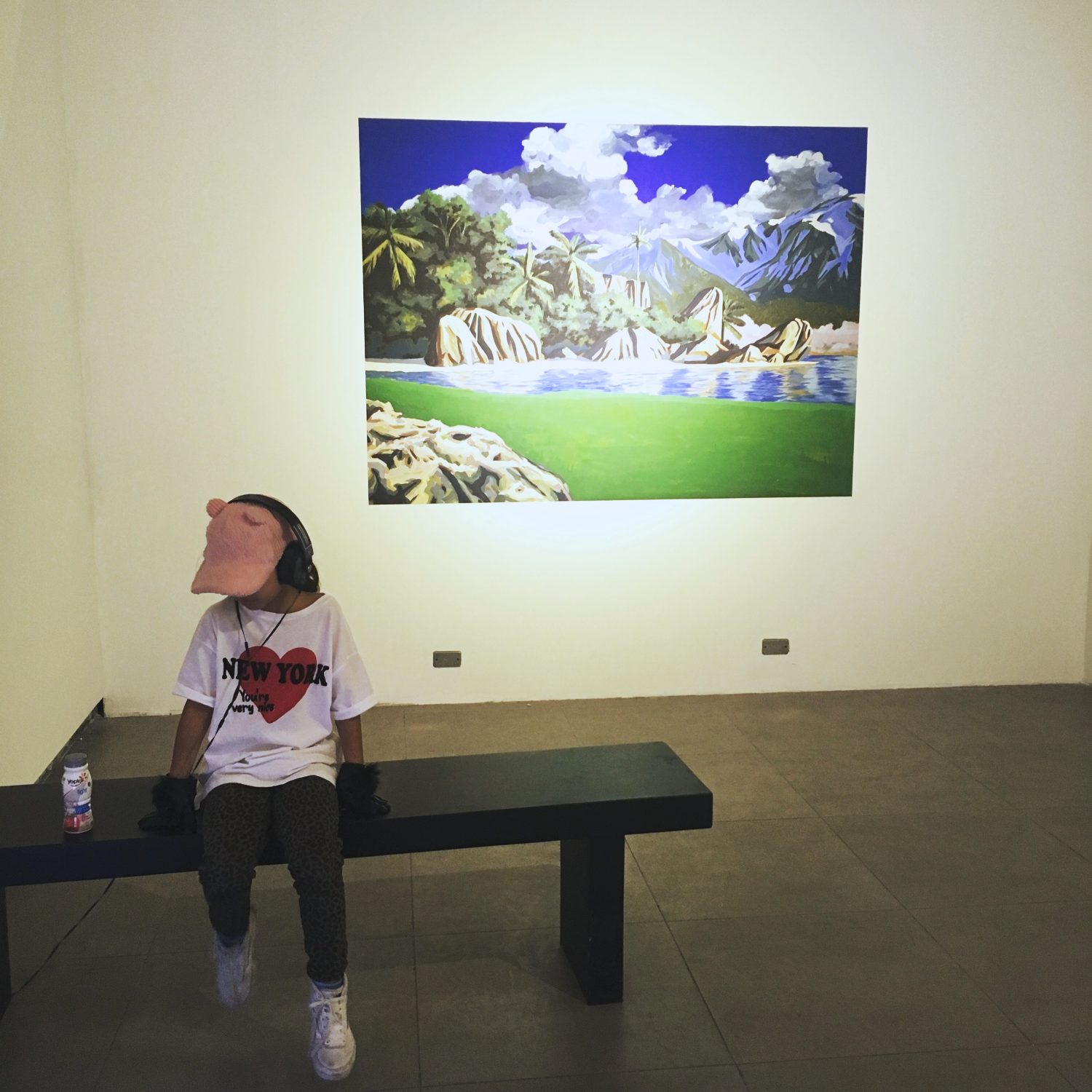
Towards the back wall, a larger-scaled painting with jagged angles in vibrant blues textured, ragged greens, and crisp whites stood out as a lovely landscape. Perhaps, one of Costa Rica’s micro-climates. Unfortunately, there was no clear label and at the very least it was not easy to locate one for the artist. And just as mysterious, a television was sitting on the floor. The video presented close-ups of a paint brush’s strokes on canvas. Subtexts translated the information to the viewer. Even though the landscape painting, television, and smaller works lacked to inform the public with educational content, there was something pertinent about the ambiguity of place, space and time in the art.
It almost felt as if I did not belong at the location, as I stared with wide eyes. It’s a pleasant environment where the terrain and objects in the smaller paintings made it all feel like home, but I wondered if the viewer was expected to feel this way. Just like an advertisement sells the idea of a faraway place making one feel relaxed and at ease. Or, do we take environments such as depicted in the landscape for granted?
Although MADC has a fantastic center gallery with high ceilings and vast walls to take advantage of with prolific works of art, I lamented the barren walls that bounced off the voices of a large group of school children. Nonetheless, I appreciated the density of the space and its ability to include the public’s presence in the white cube. It’s a public spectacle only visible to those at its inception. Once I descended to the zig zagged corridors, large paintings greeted my eyes. How refreshing!
MADC ( Museo de Arte Contemporáno & Diseńo, Gallery ( Corridor) Second Gallery to Main Entrance
The curator Daniel Soto Morúa organized the group exhibition Modernos & Universales. Its central theme revolves around ” preserving the explorations of painting and as a preferred language among artists, collectors, fairs, and museums.”
Moruá invited Adolfo Ramírez, Andrés Murillo, Rebecca Martinez, Roberto Carter, and a few others to present works to the public who “can appreciate palettes of color, themes, lines and other formal concepts, contexts, and discourses that speak evidence of infinite possibilities.” From the listed artists, it is the works of Roberto Carter whose explorations denote Moruá’s statement- a fresh and untainted relationship between a painter, the brush and the canvas.
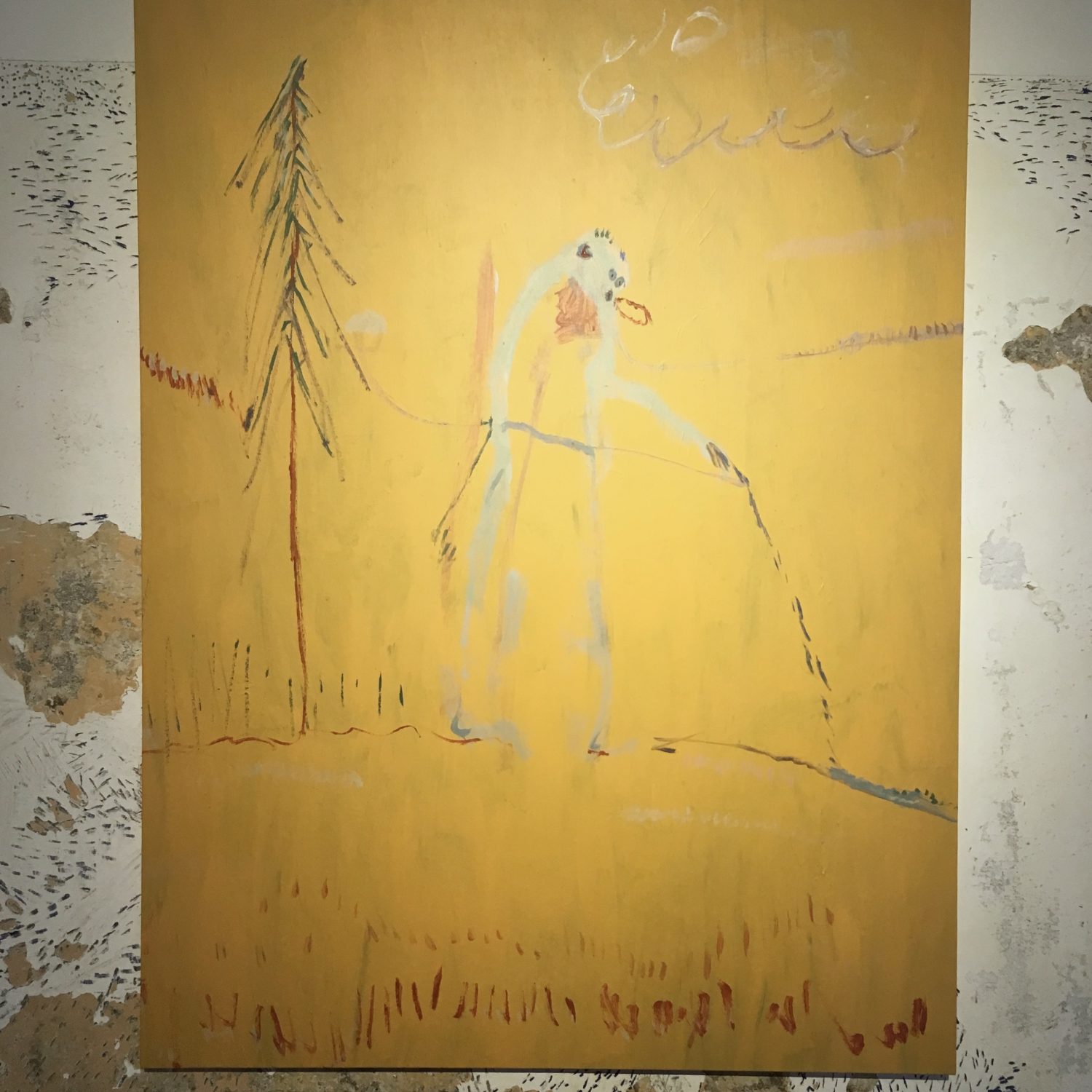
Figuras en su Paseo Diario, 2018 is a fun, young at heart painting in a rich umber yellow. The strokes are linear, simplistic markings in primary colors of reds, blues and green. Each mark resembles a scratch in thought. The subject stands tall in the center plane and seems to pour specks of blue water onto the hillside. It is a minimalistic animation. Perhaps it is the artist feeding the somewhat famished environment, or maybe he is reliving his boyhood memories of playing in the wild, charming the viewer to think they are a significantly playing along.
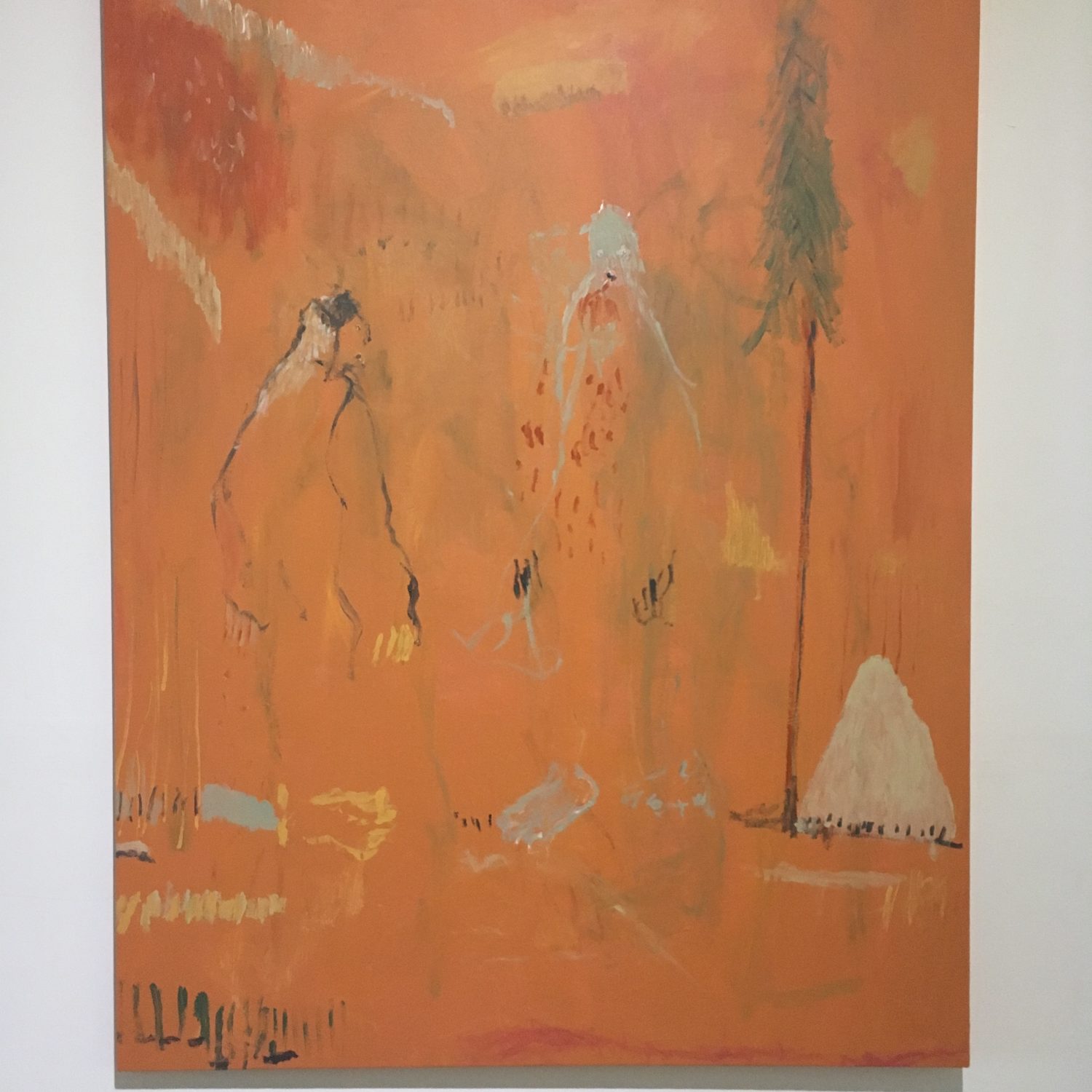
Figuras en Su Paseo Diario, 2018, Acrylic on Painting 2 Figuras Interactuando Junto al Arbol, 2018, Acrylic on Painting
2 Figuras interactuando junto a un arbol, 2018 then shows the same environment in a dusky, peachy rose. This time the setting presents a second form standing parallel to another in a laid-back, slouched demeanor. Both subjects appear clueless yet content in a” now what” unspoken conversation. What importance does the environment contain to the artist or is it the same ambiguity of space, place and time I noticed before in the smaller gallery? Carter begins to reform his environment by concealing the background under thin layers of paint in Figuras de su Paseo, 2018. It is by the process of elimination that we start to understand Carter’s intention to remove the subject from an entirely, realized environment.
The painting exhibition was a treat to see considering the saddening news of a disinterested public in contemporary art in San Jose. There are artists whose works should grace international news. Muruá like a few other curators in San Jose need all the support they can get from the art world outside Costa Rica. I hope this year the International Art Festival will succeed last years tragic mishap of failed contracts and logistical problems in the city.* So much awaits the new generation of Central American Artists and their voices must not fall to the wayside.
- I investigated the topic on the International Art Festival: no information was available online. Residents ranging in a variety of backgrounds sat during the interviews. All statements provided the same information.

Written by Beláxis Buil

- 7 years ago
-

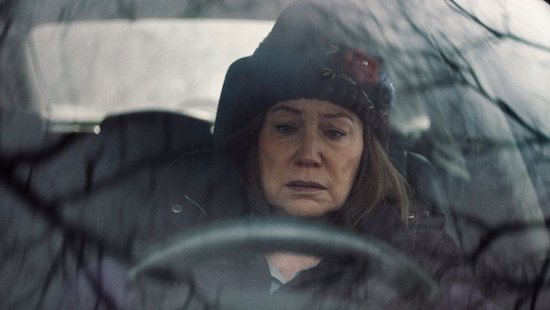
Courtesy of IFC Films Diane, the narrative debut by Kent Jones (director of the New York Film Festival) is a thoughtful, deeply affecting film, especially so for viewers who are middle-aged or older, or have recently been touched by death. (Though all but the most shallow of viewers will probably feel something.)
The film, which stars Mary Kay Place in one of the most intense and substantial roles of her career, is the portrait of a woman who busies herself caring for those around her while struggling with shame, loss and no less than the meaning of life itself.
In many ways she is like all of us, which is why the movie resonates. Ostensibly a simple story of an ordinary life in a New England town, Diane almost furtively tackles the Big Issues. The film starts off stylistically straightforward, with close-ups of mundane kitchen items and conventionally framed conversations, before becoming progressively more surreal, as if showing how we, like Diane, are part of a bigger picture that we can’t really control, or even grasp at times.

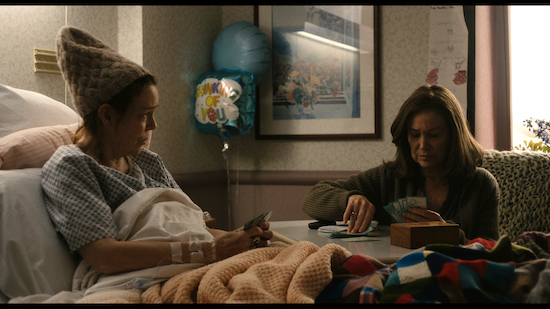
Courtesy of IFC Films We first see Diane asleep in a hospital room chair, as the room’s occupant, her cousin Donna (a sharp Deirdre O’Connell), asks if she’s OK. Throughout the movie, various friends, relatives and acquaintances will inquire about Diane’s well-being, as she cares for them. A retired widow, she brings food to ailing neighbors and volunteers at a soup kitchen with her friend Bobbie (a sympathetic Andrea Martin). She also visits her son Brian (Jake Lacy), a relapsed drug addict hostile to his mother’s entreaties to get help.
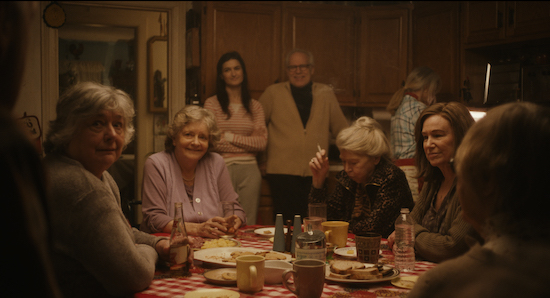
Diane has dinner with assorted friends and relatives, all of whom are openly concerned about the toll Brian’s plight is taking on her. “You’re not alone,” they insist, echoing her words to Brian. And indeed she is surrounded by a caring, close-knit community. The excellent cast of older actors includes Estelle Parsons as Diane’s aunt Mary, Donna’s mother; mother and daughter are amusingly blunt and classically New England in their ways, which makes for some light moments.
Diane repeatedly drops in on Brian, who is in worse and worse shape, until one day he disappears, which begins her unraveling. During a hospital visit with Donna, an old betrayal surfaces, and it becomes clear that this is the impetus behind Diane’s actions. We’re exhausted for her, as she drives a regular circuit that includes Brian’s place, the hospital, the soup kitchen, among other destinations.

Courtesy of IFC Films When Brian finally resurfaces at a particularly fraught moment, Diane doesn’t seem especially relieved, though we understand her wariness and weariness. She is shown periodically writing down her thoughts in a journal, along with to-do lists, but her musings don’t necessarily lead to answers.
The film gradually takes on a hallucinogenic quality as it skips ahead in time and one by one, people exit Diane’s life. (Several variations on “No one lives forever,” are uttered over the course of the film.) A new development in Brian’s life flips their roles; a final scene between mother and son, touching on another of the film’s themes—forgiveness, is a poignant and welcome chapter in the film. The human connections and emotions in Diane feel real in their confusion and messiness.
By the movie’s end, we might feel a little depressed, but also a bit wiser. No matter how we struggle with relationships and try to do the right thing or what we think is the right thing in life, we all basically end up the same. Whether that’s a comfort or disappointment is something worth contemplating, as is the film itself.
Diane opens on Friday, March 29, at the IFC Center in New York City .
—Marina Zogbi
- 7 years ago
-

Gregory Siff, “You” ink, oil, crayon on canvas 2019 After missing the December shows in Miami, I was determined to get out and see what New York had to offer at Armory Week. I had planned to attend the Art on Paper opening on Thursday, but I wasn’t able to make it. So, Saturday was my day to get my art fix. I got an early start with the idea of beating the crowds and catching up with some artists and curators I haven’t seen for a while.

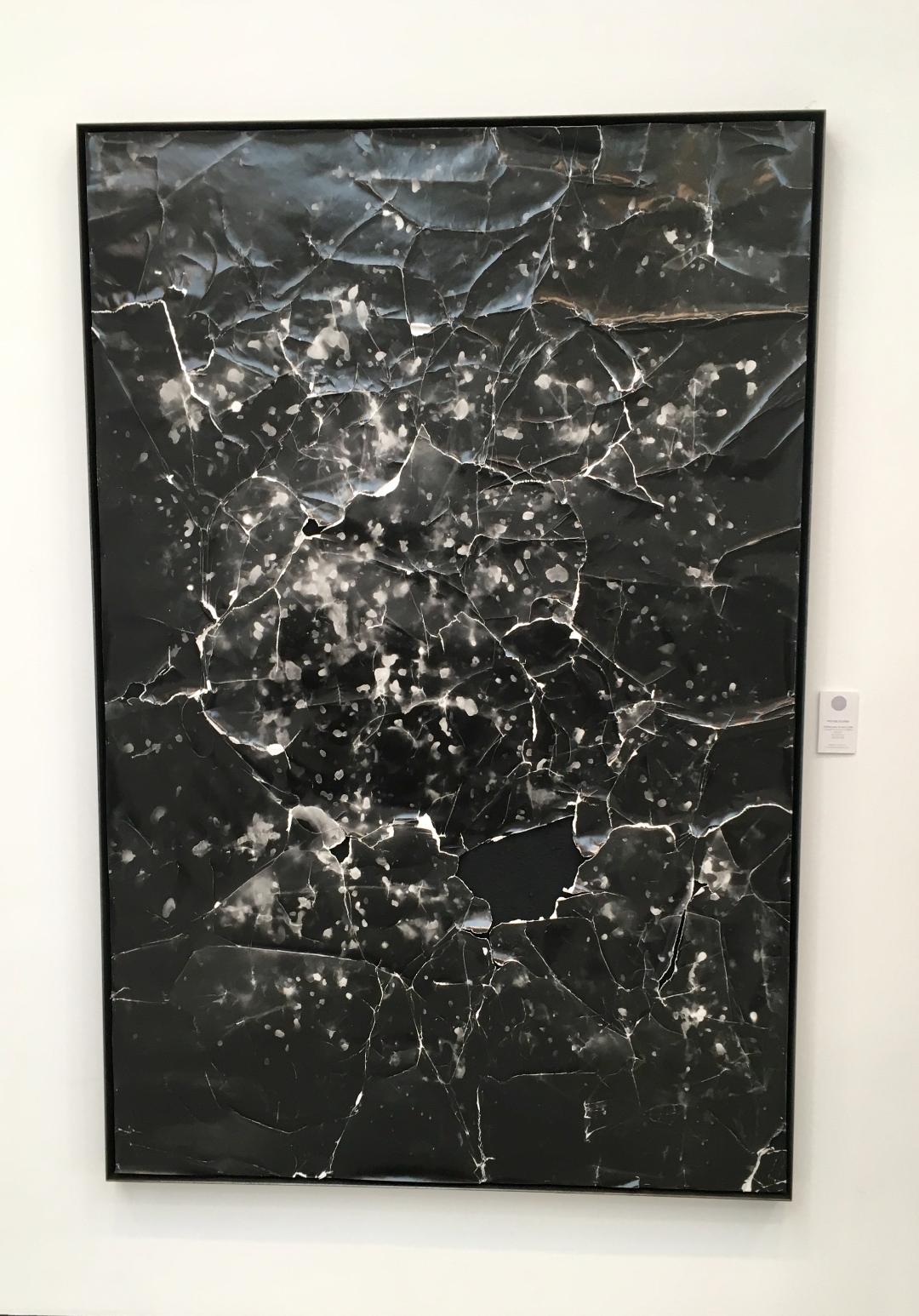
Michael Flomen, “Full Moon Rain, Number 3,” 2016 First stop was Plan B, which was one of the smaller shows- a pop up art show created by a group of gallery owners when Volta was cancelled. Sometimes you can find some really intriguing work at the smaller shows. For example, this piece by Michael Flomen (“Full Moon Rain, Number 3”) caught my attention. It’s quite minimal, but very creative. The Canadian born Flomen collaborates with nature using photogram’s to create these unique pieces. The black pigment, cracked surface and contrast got my initial attention and required a closer look.
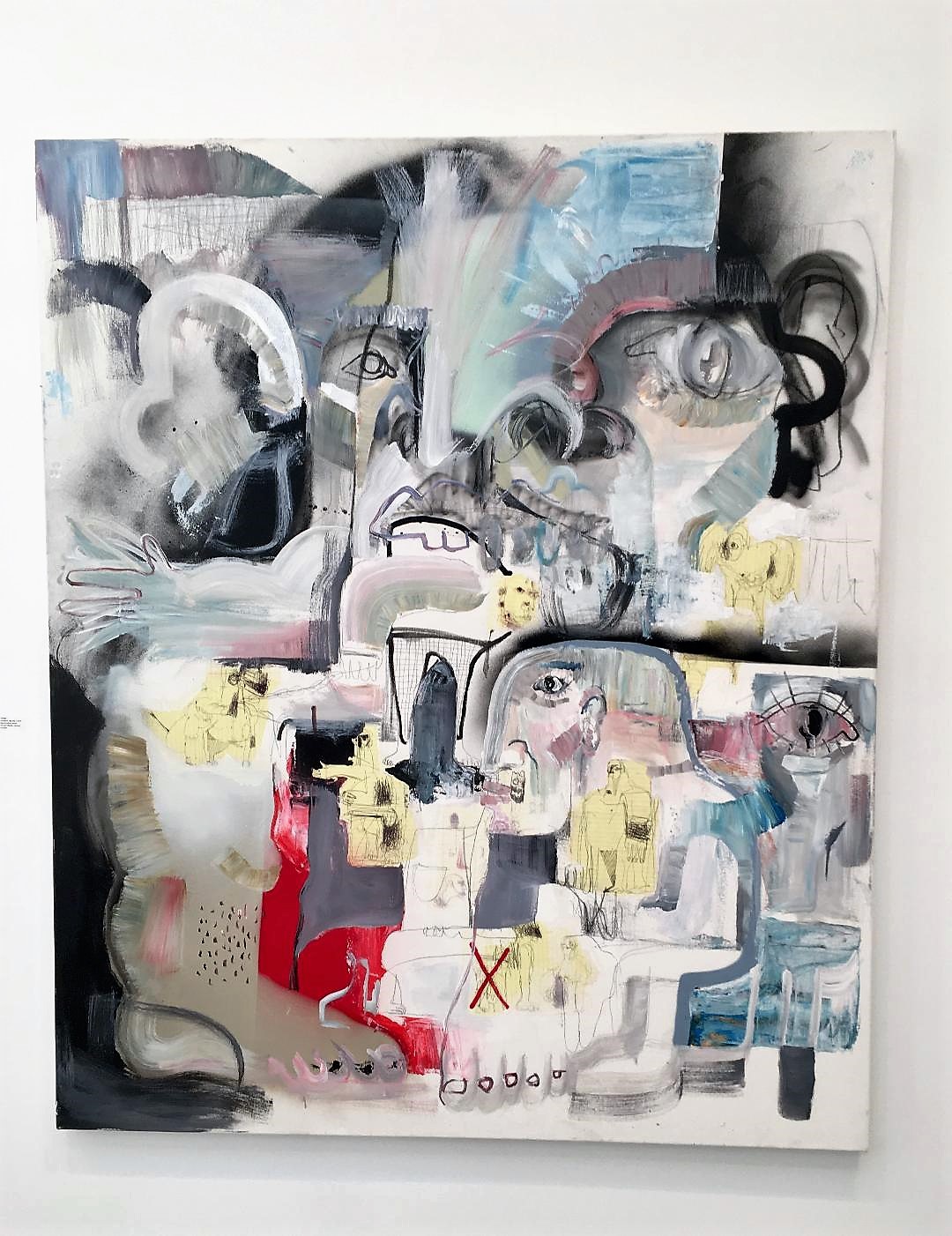
The other artist that caught my attention at Plan B was Jongmin Joy Kim, a NYC transplant from Korea. His expressive, colorful abstract work was fun and had a street art vibe.

Jongmin Joy Kim, untitled, 2018 Our next stop, which is usually very good in Miami was Scope. I did attend Scope in New York in 2018 and found it to be disappointing. So, I was curious to see how the show would compare to last year’s show.
Upon entering, the work of Thomas Canto quickly caught my eye. Once again, it was work that appeared to be on the minimal side of things that was grabbing me, but much like the work of Flomen, there’s also a unique creative element to Canto’s work that deserves more attention. The French born Canto is a multi-discipline artist who’s paintings reflect his interest in urban architectural environments. His objective of having the spectator immerse themselves in the work is quite effective. In the piece below, titled “Polygon Inertia,” the depth and illusion in the work is what captures the viewer.

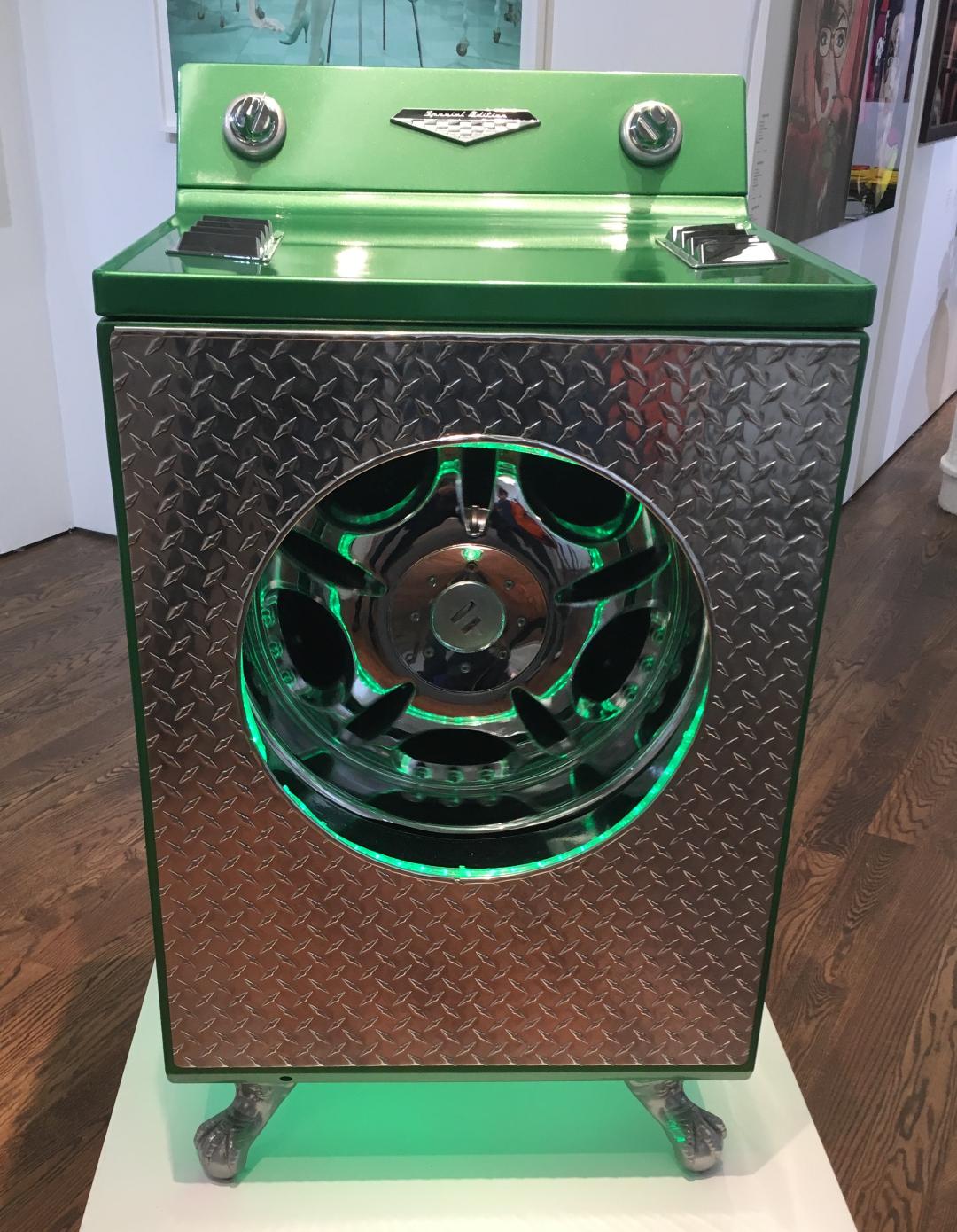
Thomas Canto, “Polygon Inertia” Mixed Media One of the other more fun and creative pieces to be found at Scope was from artist Taylor Pilote, titled, “They See Me Rollin.” Made from a GM electric dryer- the artist placed a chrome rim inside the dryer door, put some claw feet underneath and painted it with automotive paint. Of course, the rim spins along with the barrel of the dryer. I’m not sure how this fits in someone’s home as a piece of art, but it’s cool nonetheless.

Taylor Pilote, “They See Me Rollin” I found Scope to be improved over last year’s show, and although Scope is generally focused on more commercial work, Canto and Pilote’s work were refreshing and engaging.
Our last stop of the day was Independent New York which has a reputation of exhibiting contemporary, cutting edge art. The 50 Varick Street studios were by far the most ideal space for art with its sun drenched towering ceilings and glistening white walls. I was excited to see my friend Natalie Kates who heads up Latchkey Gallery. It was nice to catch up a bit and talk about the other shows. After a quick chat, we were of to explore the many floors of art, Independent had to offer.
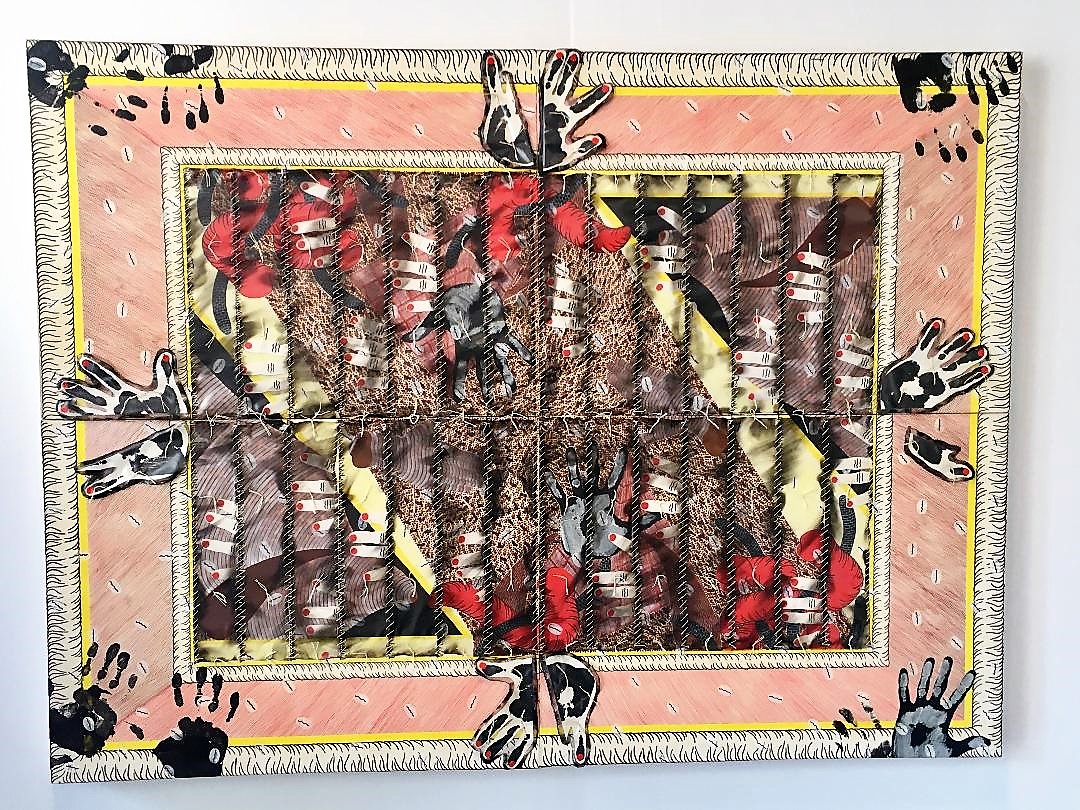
The work of Franklin Williams caught my attention right away. Though it is visually appealing, his use of various media and the influence of fashion design in his work peaked my curiosity. The piece below titled, “Flourish or Flounder” was created by the artist in 1974. it’s acrylic on paper mounted to canvas with crochet thread and vinyl.

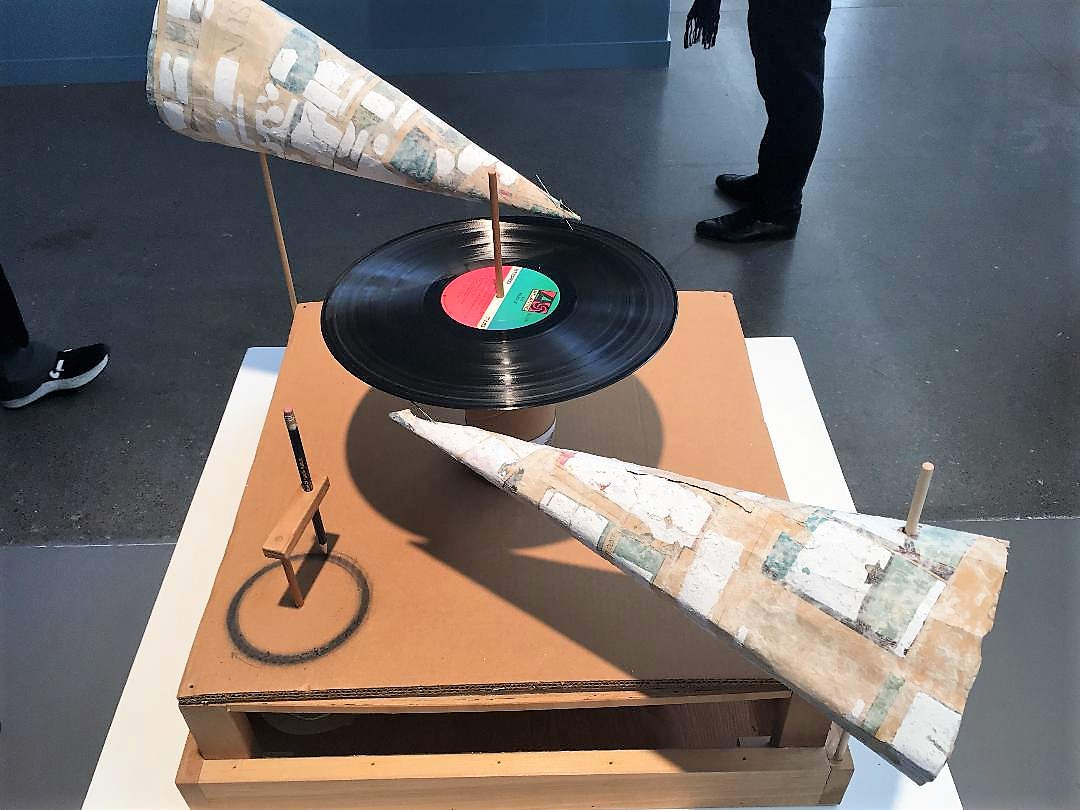
Franklin Williams, “Flourish or Flounder” 1974 Keeping in the thread of really creative work, I came across this piece titled, “Double-Sided Record Player” by Colter Jacobsen. Apparently, it plays the record on both sides. Noticing the record from the band, “Yes,” it became a conversation about choice of music as well.

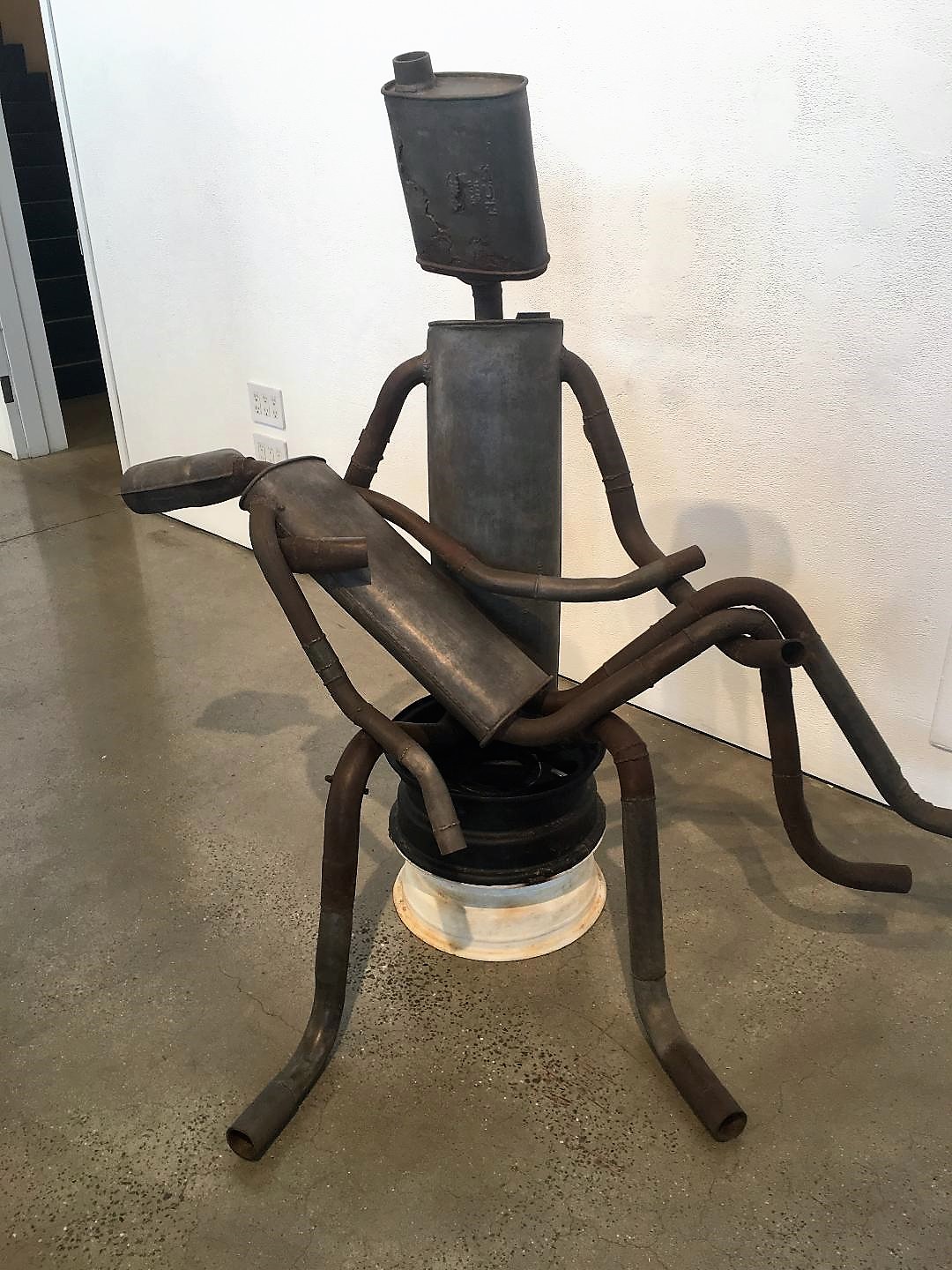
Colter Jacobsen, “Double-Sided Record Player” 2011/14 The work of LA based sculptor Matt Johnson was exhibited by Marlborough Gallery. This fun piece was created using classic mufflers and exhaust pipes for cars. It’s covered in bronze to endure the harsh weather elements outdoors. It would be a great addition for someone’s sculpture garden.

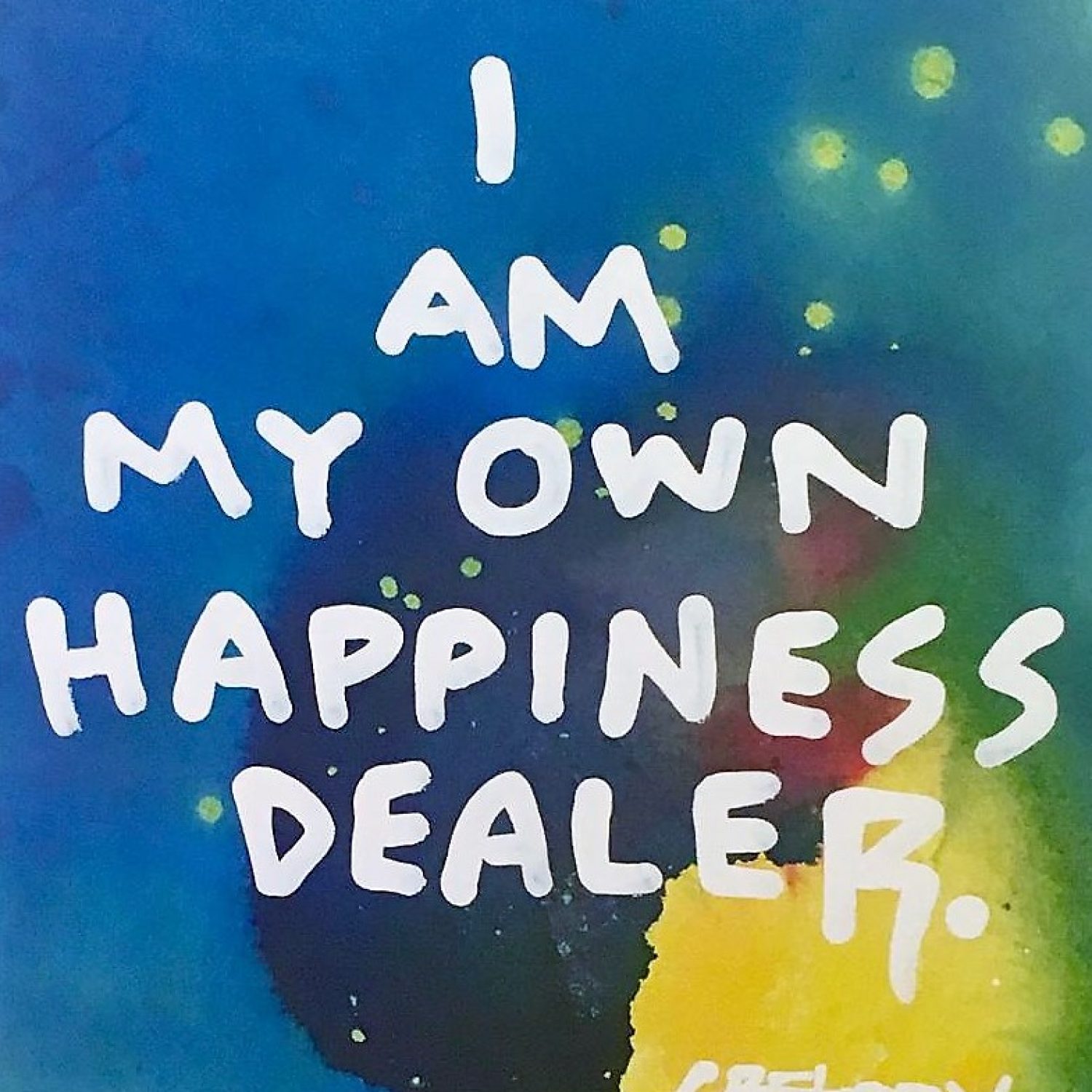
Matt Johnson, title unknown Overall the shows were quite enjoyable, and as the artwork at the top of my post suggests, “I am My Own Happiness Dealer.” On this day and quite often, my happiness comes from art.
These are just some highlights from the shows I attended. I’ll post more work on our social media channels with this blog entry.
-Frank Jackson

- 7 years ago
-
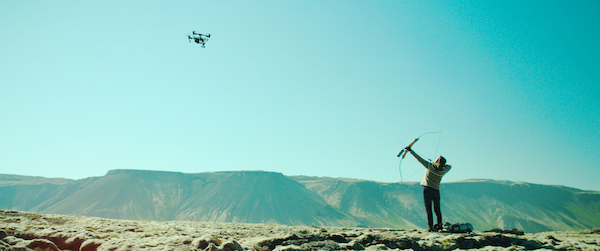
A truly original work from Icelandic director Benedikt Erlingsson, Woman at War is a whimsical action film about a middle-aged eco-terrorist fighting local industrialization. Starring the wonderful Halldóra Geirharðsdóttir as Halla, an upbeat choir director who secretly dismantles power lines in her spare time, Woman at War is also a musical of sorts, with both an Icelandic combo and a Ukrainian vocal trio punctuating the action. It’s doubtful that the issue of environmental conservation has ever been handled in such a delightful manner.

Courtesy of Magnolia Pictures When we first meet Halla, she’s busily cutting down power lines that mar the gorgeous, almost otherworldly-seeming Icelandic countryside, as musicians playing percussive tuba, organ and drums look on. When she tries to escape a surveillance helicopter, Halla comes upon a gruff but sympathetic local farmer (Jóhann Sigurðarson), who agrees to help her. Apparently this is not the first time she’s sabotaged the power project.
Later, when Halla shows up for choir practice, one of its members takes her aside and begs her to stop her activities. Baldvin (Jörundur Ragnarsson), the only one who knows her secret mission, is a government minister who initially supported her, but now thinks she’s gone too far. Not only has China gotten cold feet about doing business in Iceland, but, the U.S. has launched a satellite to monitor the area. Meanwhile a young Spanish-speaking foreigner (Juan Camillo Roman Estrada) is taken in for questioning.
As Halla practices tai chi at home amid posters of Gandhi and Mandela, the power-line sabotage is all over TV, with much speculation about the “green army” that is impeding the country’s industrial progress. Meanwhile, she receives a letter about an adoption application she filed years before. (The musicians, now playing in her house, watch this development with curiosity.) Halla must decide whether to take in an orphaned Ukrainian girl, which would obviously complicate her current life.
At this point, a trio of singers wearing traditional Ukrianian dresses appear to add their beautifully plaintive musical commentary to the film.
Courtesy of Magnolia Pictures Halla discusses the adoption with her yoga-teaching twin Àsa (also played by Geirharðsdóttir), who encourages her to do it (having no idea about the eco-terrorism). Halla — the film’s title obviously refers also to her internal conflict — isn’t so sure. She distributes a flyer declaring her mission and exhorting others to rise up and “Stop the war against the earth,” signing it “The Mountain Woman.” As the flyer is photographed, texted and posted on social media, we see the tuba player receiving one of the texts, one of the film’s many droll moments. The mysterious Mountain Woman becomes the subject of even more frenzied news coverage.
The tough, resourceful Halla continues her mission amid the rock formations of the beautiful Icelandic highlands with her biggest move yet. This involves going head-to-head with pesky drones, disguising herself as a sheep and generally acting like a badass superhero. (Impressively, Geirharðsdóttir did all her own stunts.) The hapless Spanish foreigner keeps getting apprehended by authorities, though he’s clearly just a convenient scapegoat.
The action builds to a scene at the airport, resolving in a classic twist (which is nonetheless satisfying). Though some nuances are doubtlessly lost on those unfamiliar with Icelandic culture (like this writer), Woman at War is still immensely enjoyable. To his credit, Erlingsson has made a somewhat surreal yet controlled film that is both pointed and playful. No easy feat to pull off so skillfully.
Woman at War opens in New York on Friday, March 1, at the IFC Center and Landmark at 57 West.
—Marina Zogbi